Showing posts with label read aloud. Show all posts

Tuesday, January 24, 2012

Ghosts and Ballet and Mini Reviews, Oh My! (Some read-alouds for the 7-12 age range)


The Children of Green Knowe (L.M. Boston). The story of young Tolly who goes to live with his kindly Great-Grandmother OldKnowe whom he has never met, in an old manor in the English countryside and finds it benevolently haunted by the spirits of three children (Tolly's ancestors) who died during the Plague in the 1600's. Lonely Tolly loves exploring the grounds with their whimsical topiaries, and learning about the history of the house and his ancestors and the three children, Toby, Alexander and Linnet.
Originally published in 1955, this book has a gentle, old-fashioned feel, with a delicious bit of shiver to it. It somewhat reminds me, writing-wise, of Frances Hodgson Burnett's books.
It's suitable for good readers from ages seven and up, it would also make a good read aloud (if your children are okay with the idea of ghosts. Mine are not, even though the ghosts in the story are benevolent.) It is the first of a series.


Ballet Shoes (Noel Streatfeild). Great Uncle Matthew is passionate about collecting fossils and other natural items, and fills his large house with the things he's collected on his travels, including the three abandoned baby girls -each under different circumstances- he brings/sends home on three separate occasions to his niece, Sylvia. When GUM (Great Uncle Matthew) disappears and money gets tight, Sylvia takes in a motley assortment of boarders who all teach the girls something, which allows the three very different but devoted "sisters" to come into their own. 
Written in 1936, it was really quite a progressive book for it's time, when you think about it, in terms of its treatment of women and careers. I like that it shows, in a rather vague way, that every person has something to teach us.
I'm remembering the scene in the movie You've Got Mail, where Meg Ryan's character kind of gushes over this book and the other "Shoe" books by Noel Streatfeild. I'm sorry to say I can't gush, but it was a good story, with solid writing and interesting characters. It just didn't grab me. Maybe because the problems the family faces are easily and conveniently solved with no real character growth on anyone's part. Although it's not one I'm personally anxious to read aloud to my girls, it would make an good read aloud, especially if you have little dancers in your family.
This is the first time I've read this children's classic, and I wonder how I'd have reacted if I'd read it at the right age. Maybe then I would have gushed, but I doubt it. Even then I liked a little more dramatic tension in my stories. (I wish the publisher had put in more pictures by Diane Goode in this version I read. It was too slim on the illustrations.)

Sunday, January 22, 2012

Family Stories: The Ingalls Family

Little House in the Big Woods (by Laura Ingalls Wilder) was the first book I read aloud to my girls. Olivia was three and a half years old, Karina was two and Susanna was in utero. We had already read the My First Little House Books, which I had come across at our small local library, and Olivia kept wanting more stories about Laura. But there weren't any more of those books, so I decided to feed her desire by reading her the original book Little House in the Big Woods. It had the added advantage of being about a girl that was close to Olivia's age (Laura is four in that first book) and her family life in the big woods of Wisconsin.

I took it slow, reading only about half the chapter every day. I knew she had an excellent attention span and comprehension for someone her age (a result of being read aloud to almost from birth combined with no television viewing) but some of those chapters have long descriptive passages that were beyond her knowledge base and so could easily lose the attention of one so young. Olivia loved it. It delighted her to encounter the expanded episodes she was familiar with from the My First Little House Books. (I think the pace we took was perfect for her.)  To this day she remembers the story of Ma slapping the bear (thinking it was Sukey the cow), and cousin Charley's version of The Boy Who Cried Wolf, where his trouble-making lands him in a yellowjackets' nest, and he has to wrapped in mud and linens to bring down the swelling.

Coincidentally (or maybe not) this is the first novel I remember being read aloud to me, and it made a big impression on my young mind, too.

For those of you unfamiliar with this book -is there anyone unfamiliar with this book?- it tells the story of a family living in the woods of Wisconsin in 1872. Pa is a tall hard-working brown-haired, brown-bearded man with twinkling blue eyes, adored by his little girls. Ma is quiet, gentle, and determined to teach her girls about manners, hard work, and self-sufficiency. Mary is the oldest daughter who, even at five years old, is always obedient and industrious. Laura is four years old, small in size but large in spirit, which frequently gets her into trouble in this and the subsequent books. Baby Carrie is the youngest. This is the story of their life in those big woods.

I remembered the books with such fond nostalgia from my childhood, but reading them as an adult gave me a whole new appreciation for them. What strikes me in reading these books is the background story that's taking place: the hardship the family experiences may be mainly from Laura's point of view, but the tension and thread under the surface is about these two adults who are trying to scrabble out a living while protecting their children as much as possible. Life was very hard for those pioneers and homesteaders. The mere act of living for pioneering people meant working from sunup to sundown just to make sure they had what they needed to see themselves through the cold winters. These are wonderful history books about the pioneering movement and spirit. The fact that Laura gives so many wonderful descriptions of what living that life entailed, means that we get a fascinating glimpse into the early settlement west. Despite what some critics of the books have said, Laura doesn't romanticize the life. She tells the good and the bad matter-of-factly. Some of the bad things that happen in this and the other books of the series have no easy, nicely-wrapped-up resolutions. She knows that life was hard, and yet they found comfort in the little things like Pa's fiddle music, an ongoing motif throughout the series. (See my post about Pas' Fiddle Project for a fun addition to your reading of this series.)

Our family has gone on to read more of the Ingalls family adventures in:
  • Little House on the Prairie where the family leaves the Big Woods because they were getting too crowded to Pa and journeys to the Kansas Territory. It tells of life on the trail in the covered wagon, the family building their log cabin and the problems of life on a flat prairie in Indian Territory (wolves, a prairie fire, etc.) (Be aware that this book contains some of the prejudiced attitudes of white settlers at the time. But I thought the scenes where Laura and her Pa discuss those issues were very poignant, since Pa recognized the problem that people like him were creating by their westward expansion -i.e. the Native Americans being booted off their land- but didn't know what to do about it. Toward the end of the book, this forced migration is something Laura witnesses.) In the end, the Ingalls family is evicted from their land by the U.S government as well.
  • Farmer Boy is about Almanzo Wilder (Laura's future husband) as a boy in on a large farm in New York state.
  • On the Banks of Plum Creek has the family leaving the Kansas territory and settling in a dugout on Plum Creek in Minnesota, before Pa builds a house with machine sawed lumber. In this book Laura and Mary go to a real school and church for the first time, and meet obnoxious Nellie Oleson. The family also has to contend with a plague of locusts, which forces Pa to walk to find a job three hundred miles away in order to feed his family and be able to buy grain for the next planting season. Ma and the girls has to cope with everything in his absence.
  • By the Shores of Silver Lake takes place five years after the family first came to Plum Creek and finds the family just recovering from a scarlet fever epidemic. Mary has been blinded by scarlet fever. and Grace has been added to the family. The family (Baby Grace has joined the family) moves to the Dakota territory, where Pa works as the pay clerk for the railroad company. And the family becomes one of the first to settle in DeSmet. (This one was our least favorite so far.)

That's as far as we've gotten in our reading aloud. We will probably revisit the series toward the end of this year, rereading Little House in the Big Woods for Susanna's benefit. She will be delighted to read about a girl who is her age. (She seems a little obsessed by that idea right now.) And my older girls appreciate it more at their "advanced" ages than they did at three and two.

 I would highly recommend the series for young boys. There are tons of exciting things that happen.

The books of the The Little House on the Prairie series:
  • Little House in the Big Woods
  • Little House on the Prairie
  • Farmer Boy
  • On the Banks of Plum Creek
  • By the Shores of Silver Lake
  • The Long Winter
  • Little Town on the Prairie
  • These Happy Golden Years
  • The First Four Years

Thursday, January 12, 2012

Family Stories: The Moffat Books by Eleanor Estes

We had a delightful time reading The Moffats aloud last year, and the girls are eager for more Moffat adventures. So I caved to their begging and pleading and am reading the second book in the Moffat series, The Middle Moffat.
If you are not familiar with The Moffats, the stories -written in the early 1940's- revolve around an American family living in Cranbury, Connecticut before and during the first World War, that includes Mama, Sylvie, Joey, Jane, and Rufus. Their father died before we meet them in the first book. Their mama supports the family with her sewing and tailoring, but it's not an easy living. There's a lot of scrimping and making do, and the children have a lot of freedom to come and go, in a manner unfamiliar to children in our day.

The first book's overarching theme is that Moffat family house, which all the young Moffats have grown up in, is only a rental, and the landlord has put a "For Sale" sign on the house. With this looming over their heads, the Moffats proceed with life.
In these somewhat autobiographical books, based on Eleanor Estes' childhood memories, each chapter of the books is a complete story about some episode in the children's lives. My girls' favorites from The Moffats were the Halloween chapter, where they make a ghost in their attic to try to scare the obnoxious neighbor boy, and the chapter about Jane losing their coal money.

The second book, The Middle Moffat (winner of the Newbery Honor), finds the family adjusting to life in a new house, neighborhood, new friends, and for Jane, a new school.

The appeal that Eleanor Estes' books have is that she is able to capture the mind set of young people, their impishness, their curiosity, how they see the world, etc., in a way that transcends the passage of time. And Louis Slobodkin's whimsical sketches helpfully highlight the story. (These books are also an interesting look at American children's lives during this time in history.)

We've enjoyed getting to know the Moffats and we're looking forward to more of their adventures.

Here are the books, in order:
The Moffats
The Middle Moffat
Rufus M.
The Moffat Museum


Tuesday, September 27, 2011

5 Simple Steps to Fostering a Love of Reading: What I've Learned As I've Watched My Girls Teach Themselves to Read

This post was inspired by an excellent blog post at Fanny Harville's Unschool Academy, which talks about linear vs. non-linear reading with young readers (specifically, her son), or "dipping" into books as opposed to reading them straight through. "Dipping" into books is a very common practice of young readers, but often not talked about, let alone understood. It can cause anxiety on the part of parents, as Fanny forthrightly discusses in her post. Go read her post; it's an important topic. I have been mulling over the whole learning-to-read-naturally in general, but especially in regard to fostering a love of reading in my girls. Here are my thoughts on the issue and what the process looks like for us. Deep breath...here goes...


We adults spend so much time worrying about our children's reading abilities, that we've created complexities where there don't need to be.

First, keep in mind two things:

Children learn to read when they have an internal incentive to do so. Sure, they can be forced into reading at home or in school, but children who are forced to read and never given the chance to foster the internal DESIRE to read, do not read well or voluntarily, for their own enjoyment. I think this is where public/private schools fail: they force kids through plodding, boring reading exercises that tend to kill the love of reading rather than foster it.

Children are hard-wired with curious minds that yearn to "de-code" the world they live in, IF they are free to de-code it in their own way. The desire to read, if fostered gently, is a natural corollary of that need to "de-code" life. It doesn't have to be a painful, unpleasant process. And it doesn't need to be forced or fretted over. We need to trust in that innate desire to learn. They will ask for the help they need. ("Mom, what does ... spell?") And parents can take opportunities to teach very brief "lessons" here and there, as the opportunity and need arises. (For example, I taught my girls their vowels to the tune of "Old MacDonald".) Do NOT belabor the point. This is about their learning in their way, not about you and your desire to impart knowledge and wisdom. (Where we, in this country, got the idea that children have to be able to read by the time they're ages five or six, I don't know. But I think it's asinine to assume that every child should be ready to read at age five.)

5 of the best, most effective ways to instill and develop a love of reading:

   1. Provide a text-rich environment.
This means having books in your home, and making frequent trips to the library. It means that your children need to see you reading books for fun. Children who witness their parents reading for pleasure absorb that this is a desired activity, especially when they see their same-gendered parent reading. (This is especially true of boys.)

   2. Strew, or strategically scatter (spread around the house, on obvious surfaces) a mixture of reading materials (e.g. magazines, specific books, maps, phone books, etc.)
A marketing strategy that works! A variety of materials gives kids experience and familiarity with text in all its various forms. And opens doors of discovery and discussion, and new interests.

   3. Read aloud to your children DAILY with expression, proper syntax and cadence.
Let me point out that audiobooks are good, but they should never replace YOU, as the read aloud adult. There is something about the physical act of reading aloud with your children sitting beside you or near you that helps their brains process the reading experience in a personal way. If your child is in a two parent home, both of you should be reading aloud to your children. It broadens their "de-coders" to hear books read "live" by different people. If you can do only one thing from this list, make it this one. Reading aloud with expression plays a HUGE role in your child's reading and language development, and is absolutely essential to foster a love of reading. This step is also key to keeping alive the love of reading in your pubescent boys, who for some reason frequently become more averse to reading for pleasure during middle grade years.

   4. Limit your children's viewing of television and their online/video gaming activity.
This is especially important in those early, pre-reading years. I know this advice will not be popular in some quarters, but TV, computers, and video gaming teach a child's brain to rely on extremely quick, constantly changing images and functions, in other words, rapid stimulation. Children who live in visual media-intense households have very little or no patience with text-rich experiences, becasue their brains haven't built those pathways. Books to media-saturated kids are boring compared to constant, ever-changing images. I have seen this time and again as the common denominator over the years with friends who lament their child's disinterest in books and reading.

   5. Find books that appeal to them, that they want to pick up and look at, regardless of the "reading level."
Yes, this includes comics. This doesn't have to be books that necessarily appeal to you and your desire to introduce them to "good" literature. If the reading level of the book they want to read is beyond their ability, or all they seem to want to read are books below their reading level, don't stress. It is the physical act of reading a desired book that is so critical. Also know that you don't have to read everything out loud. It helps keep their interest piqued if there are books that they want to read, but you won't read. I'm speaking here of kids ages 4 and up. If your baby or toddler brings you a book to read, read it, no matter what. If it's one you don't want to read, you can grab a more desirable one, and simply say "How about we read this one instead?" And if they bring you something that you know isn't going to keep them interested for long, just pull them on your lap and talk about the pictures or what's happening in the story.
  
There you have it: simple steps you can take to foster a love of reading. Your kids will take it from there. Relax and enjoy the ride. (But keep the books coming.)

 Questions? Concerns? Comments?

(Also check out an earlier post Reading Aloud: The "Secret" to Reading Success.)

Wednesday, May 4, 2011

Books Read To/By the Kids in April 2011

Reading aloud to the girls suffered dreadfully in April, but here are most of the library titles we managed to get to. And of course, they pored over our own shelves and re-read lots of favorites. I'm proud of Olivia for picking up my slack and taking it upon herself to read her 3 year old sister stories anytime she wanted them, while Mom was otherwise occupied. There's nothing that squeezes a mother's heart quite like the sight of one of her children reading a story to a younger sibling.


Written by Diana Hutts Aston
Illustrated by Sylvia Long
Non-fiction Picture Book; Ages 4 and up
(Published in 2006 by Chronicle Books)

  This beautifully written and illustrated book is a nature lover's dream. The rich, poetic prose discusses the physical qualities of eggs. And the incredible pictures featuring dozens of eggs had my 6 year-old Karina poring over this book time and again. I love them so much I plan on purchasing this book and the others Aston and Long collaborated on: A Seed Is Sleepy and A Butterfly Is Patient (not yet released).

I borrowed this from the library after I saw it featured on Janice Durant's blog Books of Wonder and Wisdom. Thank you, Janice.


Written and illustrated by Patricia Polacco
Picture Book; Ages 4 and up
(Published in 1988 by Philomel Books)

Every year old Babushka paints eggs to sell at the Easter festival. One day, when a wounded goose falls from the sky, Babushka takes her in, tenderly nurses her back to health, and names her Rechenka. When the goose accidentally breaks all of Babushka's eggs that she labored all winter to paint, Rechenka makes amends by providing a miracle.

(Again, thanks goes to Janice Durant for the book recommendation.

Written by Kate DiCamillo
Illustrated by Chris Van Dusen
Young Readers; Ages 6 and up (Younger if read aloud.)

Ah, Mercy Watson, how my children love thee!
All the Mercy Watson books are perennial favorites around our house and get re-read every few months by both my older girls (ages 6 and 7). This is one series that they can both read themselves, and they are delighted to read them aloud to their little sister. This whole series of Mercy Watson books (there are 6) got a work-out this month. Literarily, the stories are pretty fluffy, but my girls bask in the marshmallowy yumminess. And the pictures, with their fifties retro feel, add greatly to the fun.

Mercy Watson is a buttered-toast obsessed pig, and an unwitting hero. She gets herself into and out of some silly predicaments and manages to come out smelling like roses butter.

In Mercy Watson Fights Crime (the 3rd book of the series), Mercy unwittingly foils a small would-be, cowboy wanna-be house burglar.
For some reason or other, this book was read the most this month by both girls. (I heard it read aloud to Susanna WAY.TOO.MUCH!)
(We've also borrowed the audio CDs before and they are well done. The girls like listening to them at night.)

Here are the other titles:


Written by Katherine Paterson
Illustrated by Leo and Diane Dillon
Picture Book; Ages 4 and up

When a Japanese lord sees the beautiful plumage of a male mandarin duck, he orders his capture. In captivity, the male pines for his mate and begins to die. Appalled at his plight, a maidservant sets the duck free, and she and the Lord's one-eyed steward are sentenced to death for their perfidy. Help comes from unexpected quarters, and the two disgraced servants must flee for their lives. Find out what happens next in this beautifully told and illustrated story of compassion, courage, heroism, and loyalty.

Written by Sarah Stewart
Illustrated by David Small
Picture Book; Ages 4 and up
(Published in 1997 by Farrar, Straus, Giroux)

My girls and I so loved this Caldecott Honor book about a young girl who is sent to live with her uncle in the city because her father is out of work. Set during the Depression and told in the form of letters -first to her uncle and then to her parents and grandma at home in the country- Lydia Grace transforms her Uncle's drab life and bakery, one plant at a time, into a bower of blooming brightness.

Written by Munro Leaf
Illustrated by Robert Lawson
Picture Book; Ages 4 and up

It's hard to believe that this book about a gentle bull who only wants to sit "just quietly" and smell the flowers, was once banned by Franco of Spain. First published in 1937, a few months before the outbreak of the Spanish Civil War, Francisco Franco saw the book as a message of pacifism directed at him and banned the book from Spain.
To me this book's timeless message is about being true to yourself and that being different is okay. I loved this story as a child and my girls love it, and enjoy re-reading it. They laugh hysterically when Ferdinand sits on the bee, and at the illustration showing his expression. And they laugh at the bullfight scene.


Tuesday, March 29, 2011

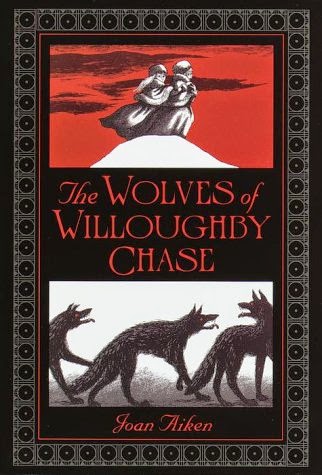
Book Review: The Wolves of Willoughby Chase by Joan Aiken

Written by Joan Aiken
Illustrations by Pat Marriott
Middle Grade Fiction (RL 5.6)
Ages 8 (younger if read aloud) and up

This story starts in wintertime, when the wolves of the English country wolds are starving and roaming in packs to bring down anything they can. Into this world comes shy, young Sylvia, sent away from her aunt in London to be the companion and playmate to her cousin Bonnie Green of  Willoughby Chase. After a harrowing train journey, Sylvia arrives and is warmly welcomed by the effusive, hoydenish Bonnie. The next day sees the departure of Sir Willoughby Green and Lady Green, bound overseas for poor Lady Green's health. The girls are left in the charge of the new governess, Miss Slighcarp, whose true evil nature is revealed upon the parents' departure. In short order, she dismisses all the servants except a handful of the worst ones (and one who only pretended to be bad so he could stay on and watch over the girls), sells the furniture and pockets the money, takes away all of the toys, and locks Bonnie in a cupboard. With the help of James, the loyal servant who stayed on to watch over them as best he can, they discover that Miss Slighcarp has truly nefarious plans for Willoughby Chase. But when the girls try to solicit outside help, they are discovered and sent away to an orphan school run by Mrs. Brisket. At the school, their life is one of drudgery, harshness and hopelessness until one day, a young boy from the wolds by Willoughby Chase comes to find them and help them escape. But where will they go?

We've finally finished the book! And what a grand adventure it was! Set in Victorian England, this story had all the plot elements guaranteed to keep my girls glued to the story as I read it aloud to them. They Ate. It. Up. It's a story that probably works best as a read-aloud the first go-round. The language structure is perfect for the story, old-fashioned, reflecting perfectly the age in which the story takes place, although the story itself was written in 1962. But it might be harder for children who have never been exposed to that antiquated structure to follow, which is why I suggest reading it aloud first.

I had so much fun reading this aloud. It was such fun giving life to all the wonderful characters. The names of characters make me laugh, they're so deliciously perfect for a book set in this period: Pattern (the maid), Miss Slighcarp, Mr. Grimshaw (the accomplice), Mr. Gripe (the lawyer), Dr. Morne, Mrs. Brisket, Mr. Wilderness, etc. And the internal pictures by Pat Marriott have a vagueness that adds splendidly to the menacing feel. (The cover illustration is by Edward Gorey. Isn't it wonderfully sinister?)

If you are looking for old-fashioned Victorian adventure story, with Gothic elements, plucky heroines, nasty bad 'uns, then this is the story for you.

Wednesday, March 23, 2011

Book Review: Wind Child by Shirley Rousseau Murphy; illustrated by Leo, Diane, and Lee Dillon


Wind Child
Written by Shirley Rousseau Murphy
Illustrated by Leo and Diane Dillon and Lee Dillon
Ages 4 and up

"She wanted to know the winds' secrets and what they shouted when they sped across the sky. She yearned to fly as the winds flew, to feel the grasses brush her toes, to leap high above wind-tossed waters."
Resshie grows up ignorant of her true parents, but with a strange longing and affinity for wind. She supports herself by weaving cloth, and soon her cloth is the most coveted in the land for its special unearthly qualities. But Resshie, in weaving cloth for others, realizes she is lonely and wants a husband like other girls. Not liking anyone in her village, Resshie sets out to make her perfect companion, with imperfect results.

This story reads like a Greek myth and fairy tale rolled up into one. The text flows beautifully. My girls sat silent and rapt as the story unfolded. Each picture has a dreamy, windswept feel to it, and each contains the omnipresence of wind: hair blowing, dresses blowing. And the conclusion is perfect.

This book seems to be out of print, but you should be able to find it at your library. I highly encourage it, especially if you or your children like myths and fairy tales.


Book published in 1999 by HarperChildrens for Harper Collins
This copy borrowed from the library.


Thursday, March 10, 2011

Book Review: Love, Ruby Lavender by Deborah Wiles

Ages 8 and up

WELCOME
to Halleluia, Mississippi
Population:
400 Good Friendly Folks
And a Few Old Soreheads
Nine year old Ruby Lavender and her muumuu wearing, champion-of-lost-causes grandmother, Miss Eula, are best friends. The two of them "liberate" three hens from Peterson's Egg Farm -saving them from certain death-, go on picnics, share secrets, and have their own secret mailbox tree, where they constantly exchange letters.
Then Ruby's anticipation of another summer of fun with Miss Eula is dashed when her grandmother tells her she won't be there this summer; she's going to Hawaii to visit her son and her new little granddaughter.
Crushed and a little jealous, Ruby writes to her grandmother while she is away, telling her all about the summer's happenings -her confrontations with her arch nemesis Melba Jane; caring for the Ivy, Bemmie and Bess, the 3 "liberated" hens (she reads them the dictionary for their bedtime "story"); testing her mother's garden-fresh recipes (which she loves); sweeping the floors of her Aunt Mattie's store (which she hates); meeting her new teacher; making a new friend.

This was a fun read. The characters are strong, interesting, and there's enough action to drive the story forward. And I love reading stories about strong family connections and families who love each other.
And I love reading books where the characters learn important lessons about forgiveness, especially when they are not pedantic.
This book would make a wonderful read-aloud, even for kids as young as six.

Themes: family bonds; small town living; friendship; death and loss; dealing with people you don't like.


Book published in 2001 by Gulliver Books, a trademark of Harcourt,Inc.
188 pages
Borrowed from the library

Thursday, February 17, 2011

Book Review: A Tree For Peter by Kate Seredy

A Tree for Peter
Written and illustrated by Kate Seredy
Original Copyright 1941
Published in 2004 by Purple House Press

Peter is little, lame, fatherless, poor and "afraid of many things." His mother has to work every day in the city and he spends his week alone and frightened, living for Sunday, her day off. They live in Shantytown, an area of old abandoned houses that the poorest of the poor are squatting in as they try to eke out a meager living: it is a people and a place without hope. Until one day, small Peter meets Peter King, an old tramp who befriends him and teaches him to stop being fearful of life. As his outlook changes, he starts making friends, first with a mangy dog, and then with the Irish cop whose beat includes Shantytown. As he changes, he starts changing the world around him, little by little. From Peter King's kindness, a chain of events builds and transforms Small Peter and all the people of Shantytown.
  I loved this story. Loved it. I felt so helpless and depressed as I read about Peter being left alone day after day in those squalid conditions by a mother who clearly hated it as much as he did, but didn't have any other option. And I rejoiced when he found a kind heart to teach him to live beyond those fears.
  People of today might read the story and see only the unrealistic aspects compared to our own day: children left alone day after day without state interference; a friendship with a vagrant who turns out to be kind rather than deranged. But for me as a modern reader, I think this story still has bearing, and I appreciate the hope that drives the story, the inherent innocence of it, and the author's assumption that people are basically good and -more importantly- that one person can make a difference in the lives of others.
  Kate Seredy's beautiful, detailed, sepia illustrations accompany her amazing story, and set the tone.
  One of our family's very favorite stories, this makes a great read-aloud anytime, but especially at Christmas. (If you can get through it without weeping.)

Saturday, February 5, 2011

Reading Aloud - The "Secret" to Reading Success

  I am a passionate believer in the necessity and power of reading aloud to children. One of my earliest memories of my mother is of sitting snuggled into her arm as she read aloud to me before bed. I was three years old. My mother read aloud to me until I was 14 years old. Too old, you say? NEVER, I say.

  Reading aloud is, in my experience, the most important way to ensure a child's reading success. 

Reading stories aloud from an early age exposes children to the rhythm and cadence of purposeful, deliberate, spoken language - to the magical flow of language. It exposes them to a vocabulary and way of using words that they might not hear in their everyday verbal interactions. 
  Reading aloud makes them excited about books and stories. For this reason, reading aloud is one of -if not the best way to help a struggling reader.
  You can always spot a child who has not been read to. They read with no expression, in a choppy manner, showing no understanding of how the sentences they are reading should sound. They have no comprehension of the flow of language. To children who have never been read to, the words on the page are just that: words, to be struggled through. And I'm not talking here of just-beginning-to-read children. Children who are just beginning to read on their own will sound wooden until they get to be more proficient, then the exposure to the flow of the words will kick in - if they've had that exposure in the form of being read aloud to.

  Generally, as our children age and life gets busier, reading aloud stops. For some families it stops as soon as the child learns to read aloud themselves. What a tragedy! There are wonderful benefits from reading aloud into the teen years.

  Reading aloud can expose children to stories that are too advanced for their reading level, stories that would be too discouraging to try on their own. 

My mother started reading The Lord of the Rings series to me when I was nine. And I loved it. It led me to turn right around and read it for myself once we were done. Before that, the size of the books and the complexity of language seemed too beyond me. But reading them aloud changed my perception of "too difficult".

  Reading stories out loud that have tougher emotional issues lets you control their exposure to those issues in a safe environment. 

It gives them the "experience" without the negative consequences, and can serve as a memory when faced with real-life situations. The story can prompt some great discussions that would be too awkward to bring up under normal circumstances.

  Reading aloud can expose your kids to book options that they would normally never consider. 

I'm thinking here of my own experience with not wanting to read "boy" books, until I was read some great stories aloud. Likewise, boys exposed to "girl" stories from a young age might not turn their noses up later in life at books with girl protagonists. (No guarantees!)
  In our case, I feel it's important to read books with male protagonists because my girls don't have brothers. So it helps give them the experience of the young male perspective that they're not getting in real life.
  This also helps with subject matter that you know they wouldn't touch with a ten foot pole on their own (e.g. historical fiction), but they'll accept it readily if it's read aloud, and probably end up seeking out other books on the subject. Or not. But at least you know they've been exposed to it.

  Reading aloud creates warm and wonderful memories, and can increase the power of corresponding experiences. 

Those of you who have been read aloud to can utter a hearty amen to this.  

  Reading aloud to your pre-teen and teen can help you all slow down and connect again, even for a brief time, over a shared experience. 

And what parent can't use more bonding time with their teen? If you haven't been doing it, it may feel odd at first, but trust me, despite any awkwardness or indifference they may display, secretly they will like it.

  And last but not least - 

Reading aloud lets you share your love of books with your children.


  Can you think of other benefits of reading aloud that I haven't mentioned? I'd love to hear your experiences with reading aloud.

Friday, February 4, 2011

Book Review: The Willoughbys by Lois Lowry


 The Willoughbys
Written by Lois Lowry

 I had no idea what I was getting into when I borrowed this book from the library. I have been trying to read as many Lois Lowry books as I can get my hands on. So to that end, I ordered this sight unseen from the website, and picked it up when they called me. (LOVE that service!)
 On the cover, at the bottom I read, "A NOVEL Nefariously Written & Ignominiously Illustrated by the Author." That should give you a clue as to the tone of this book. The summery of the inside jacket flap reads:
"Shouldn't we be orphans?" one of the Willoughby children suggests one day. The four are, after all, part of an old-fashioned kind of family, and their parents - well, their parents are not all one would hope for.
Recalling literary heroes and heroines such as Anne of Green Gables, Pollyanna, and James and the Giant Peach, the Willoughbys concoct a diabolical plot to turn themselves into worthy and winsome orphans. Little do they know that Mr. and Mrs. Willoughby have already begun to formulate their own thoroughly despicable plan inspired by another favorite bedtime story: the tale of Hansel and Gretel...
From cover to cover this book was a delight for me to read. It is a satire of an "old-fashioned story", full of dastardly plots and nefarious characters, with many surprising twists and turns that touch on common themes in classic children's stories. It is the many references to these classic stories that make the inside joke of this book that much funnier.
  It's not a book that everyone will enjoy. The characters in this book are not very lovable (with the exception of baby Ruth), but you're not meant to love them. It would make a fun read-aloud book (just read it first and know your children.)
  I have to point out some funnier parts of the book that might be overlooked: the Glossary and Bibliography at the end. Please, PLEASE read them. They are hilarious! Ms. Lowry's definitions are a riot, for example:
IGNOMINIOUS means shamefully weak and ineffective. Oliver Twist saying "Please sir, might I have some more?" would be ignominious, except that he isn't shameful, just sort of pathetic. This book has ignominious illustrations. They are shamefully weak because the person who drew them is not an artist.
Her summaries of the books she makes reference to in her story are also funny.

And then go to the back flap and read the about-the-author blurb. Okay, never mind, I'll quote it here because I love it.
Influenced in her childhood by a mother who insisted on surrounding her with books instead of roller skates and jump ropes, Lois Lowry grew up lacking fresh air and exercise but with a keen understanding of plot, character, and setting. Every morning she opened the front door hoping to find an orphaned infant in a wicker basket. Alas, her hopes were always dashed and her dreams thwarted. She compensates by writing books. Today she is a wizened, reclusive old woman who sits hunched over her desk thinking obsessively about the placement of commas.
Ms. Lowry, thank you for the laughs.