Showing posts with label orphans. Show all posts

Sunday, December 23, 2012

Christmas Favorites: The Story of Holly & Ivy

The Story of Holly & Ivy
Written by Rumer Godden
Illustrated by Barbara Cooney

Loneliness and wishing are the themes of this magical classic Christmas story, first published in 1957. Ivy is a lonely orphan wishing for a place to belong. Holly is a doll in Mr. Blossom's toy shop, dressed in Christmas red and green, wishing to find her little girl, fearful of being put into storage with the mean owl Abracadabra because she hasn't been sold this Christmas. Childless Mrs. Jones aches for something she almost doesn't allow herself to wish for. How these three wishes converge and are fulfilled during this wishing time of year make for a riveting story that never feels dated because it touches on themes that are universal to the human condition. This touching story is made more poignant by Barbara Cooney's dreamy, luminous illustrations, of which there are not enough, in my opinion.

I loved this story when I was a girl, and I'm so pleased my girls love it too. This is the first year Susanna sat through the whole reading of this long picture book.


Friday, January 27, 2012

2012 Newbery Honor Winner: Breaking Stalin's Nose by Eugene Yelchin

This book flew invisibly past my radar. I hadn't heard of it or even seen it until I read that it won the Newbery Honor. Obviously, I had to rectify that, so when my latest batch of books came from the library yesterday, full of this year's award winners, I wanted to read this one first.

Synopsis: Ten-year-old Sasha is a fervently loyal Stalinist, who is excited to become a part of the Young Pioneers (Stalin's youth organization) and extremely proud of his father, who works for the State Security (secret police). They live with 46 other people in a communal flat/apartment, happy -from Sasha's perspective- that they are the living epitome of Stalin's ideals. Then, in the middle of the night, the secret police come and roughly haul away his father. What follows is a quick succession of events that has Sasha questioning his loyalty and the validity of the system.

The action of this fairly quick and completely gripping story takes place over the course of only one evening and the following day. It's a book that contains important issues such as freedom (or the lack of it), paranoia, propaganda, idealism vs. reality, standing for right (or not).


Here are some thoughts I had as I read:
  • I think Yelchin does a very admirable job of tackling his subject from a naive ten-year-old's perspective. It's a genius approach, reminiscent of Boyne's The Boy in the Striped Pajamas, where the limits of the young protagonist's understanding and maturity throws a spotlight on the horrors going on around them. What Yelchin seems to steer away from are Sasha's emotions. Deliberate devise or not, I think it's genius to downplay them, because again, it throws the spotlight onto the world in which he lives. The buildup of paranoia and hysteria that exists in the book -created by living in such a system- engulfs the reader in their own emotions. I think it would be completely overwhelming if we had to deal with both sets of emotions at once, especially for the targeted reading age group.
  • In the beginning, Sasha is the perfect little Communist, just as he's been trained from baby-hood. Even as people are betraying his family, he doesn't feel a sense of betrayal, rather he admires their patriotism. There are also a few instances where Sasha has to choose to take a stand for right, and you can't help having empathy for his choices. (You will have to read the book to understand this in context.) I think it's a credit to Yelchin's writing ability that he can make us empathize with a boy with whom we have ostensibly very little in common.
  • It's interesting to me how the author subtly shows the disconnect between child and adult. Here is Sasha's father, who has trained him to be a good little Communist from birth, and yet somehow expects him to know where the inconsistencies lie between the dogma and reality. It's a mistake we parents frequently make: assuming that our young children can see and understand those subtleties and inconsistencies.
  • Yelchin, through young Sasha, gets to the heart of why this period of Russian history is known as The Great Terror: what happens to society as a whole and the individuals within it when every infraction is treated like it's the very worst possible crime? What happens when people are kept in such a state of terror and propaganda that they don't even realize they are the victims?
  • The illustrations are dark, and have an exaggerated quality that perfectly accompanies the exaggerated paranoia. (There's an ironic one on pages 106-107 depicting the principal as Hitler.) The illustrations are reminiscent of Communist propaganda posters from the era. The other interesting thing to note is that we only see Sasha from the back or side -always turned away from the viewer- throughout the book, until we finally see his face for the first time on p. 137, just before the end.
  • This book would make an excellent accompaniment to history lessons about that era for children age 10 and up. I'd have high schoolers read it as part of a Russian history unit. I think it would also make excellent book club reading.

Tuesday, March 29, 2011

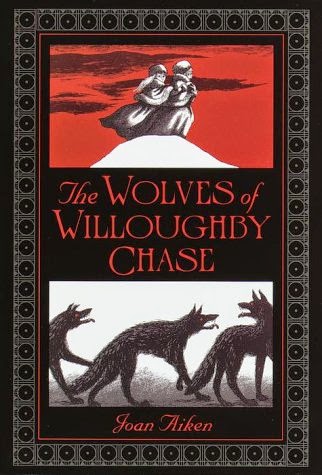
Book Review: The Wolves of Willoughby Chase by Joan Aiken

Written by Joan Aiken
Illustrations by Pat Marriott
Middle Grade Fiction (RL 5.6)
Ages 8 (younger if read aloud) and up

This story starts in wintertime, when the wolves of the English country wolds are starving and roaming in packs to bring down anything they can. Into this world comes shy, young Sylvia, sent away from her aunt in London to be the companion and playmate to her cousin Bonnie Green of  Willoughby Chase. After a harrowing train journey, Sylvia arrives and is warmly welcomed by the effusive, hoydenish Bonnie. The next day sees the departure of Sir Willoughby Green and Lady Green, bound overseas for poor Lady Green's health. The girls are left in the charge of the new governess, Miss Slighcarp, whose true evil nature is revealed upon the parents' departure. In short order, she dismisses all the servants except a handful of the worst ones (and one who only pretended to be bad so he could stay on and watch over the girls), sells the furniture and pockets the money, takes away all of the toys, and locks Bonnie in a cupboard. With the help of James, the loyal servant who stayed on to watch over them as best he can, they discover that Miss Slighcarp has truly nefarious plans for Willoughby Chase. But when the girls try to solicit outside help, they are discovered and sent away to an orphan school run by Mrs. Brisket. At the school, their life is one of drudgery, harshness and hopelessness until one day, a young boy from the wolds by Willoughby Chase comes to find them and help them escape. But where will they go?

We've finally finished the book! And what a grand adventure it was! Set in Victorian England, this story had all the plot elements guaranteed to keep my girls glued to the story as I read it aloud to them. They Ate. It. Up. It's a story that probably works best as a read-aloud the first go-round. The language structure is perfect for the story, old-fashioned, reflecting perfectly the age in which the story takes place, although the story itself was written in 1962. But it might be harder for children who have never been exposed to that antiquated structure to follow, which is why I suggest reading it aloud first.

I had so much fun reading this aloud. It was such fun giving life to all the wonderful characters. The names of characters make me laugh, they're so deliciously perfect for a book set in this period: Pattern (the maid), Miss Slighcarp, Mr. Grimshaw (the accomplice), Mr. Gripe (the lawyer), Dr. Morne, Mrs. Brisket, Mr. Wilderness, etc. And the internal pictures by Pat Marriott have a vagueness that adds splendidly to the menacing feel. (The cover illustration is by Edward Gorey. Isn't it wonderfully sinister?)

If you are looking for old-fashioned Victorian adventure story, with Gothic elements, plucky heroines, nasty bad 'uns, then this is the story for you.