Showing posts with label Young Adult. Show all posts

Tuesday, July 5, 2016

Book Review: The Good Lie by Robin Brande

This book challenged me emotionally and intellectually. I'm going to start off by saying I did not like this story, because it made me extremely uncomfortable, which is why I'm going to highly recommend that you read it. Read it now. It is a brilliant, nuanced novel about a religious girl who deals with issues outside of and at odds with her religious experience.  I thought the author did an amazing job of both respecting religion through her main character's eyes while at the same time laying bare it's glaring weaknesses. It's a book that poses more questions than it answers.

A brief synopsis: Lizzie Aimes is living her life as a normal sixteen-year-old Christian teen. She's a good student, she loves her family (especially her little 8 year old brother) and is trying to live her religion despite her sexual desires and a massive crush on a certain boy, who seems set on sleeping his way through the school's female population. Up until the night of her prom, that was her biggest problem. In the weeks and months following, Lizzie life begins unravelling in all the worst ways imaginable, culminating in her need to tell "the good lie."

While it is a novel about a deeply religious girl, this is not a religious book. There are a lot of girls like Lizzie in the world. So many times I wanted to yell at Lizzie for her actions or inactions. But having been a conservative religious teen myself, and remembering certain situations I encountered that were outside my religious training, I can understand the moral quandary and torpor she finds herself in.

As I continue to ponder this book, a week after I read it, the biggest issue that I find myself circling back to again and again, is sexual repression. It is one of the most dangerous by-products of religion, in that it creates an atmosphere ripe for pedophilia to thrive in the religious world, as too many children have found out. It takes away children's voices; since they're never allowed to talk about sex, they don't have the words or knowledge of how to report abuse. One of the major themes of The Good Lie is that dichotomy of sexual repression and the conservatively religious teaching/drilling of sexual abstinence and purity of mind and body when it bumps up against the harsh reality of world scenarios, and how damaging it can be for women and children. 

So, go read this book and be challenged.
 

(Be aware that this book is for mature readers. It contains profanity and frank language regarding sexual functions and situations, and pedophilia. While none of it feels gratuitous, it can be shocking.) 

Wednesday, February 11, 2015

Book Review: Shadows by Robin McKinley


Synopsis from the publisher: Maggie knows something’s off about Val, her mom’s new husband. Val is from Oldworld, where they still use magic, and he won’t have any tech in his office-shed behind the house. But—more importantly—what are the huge, horrible, jagged, jumpy shadows following him around? Magic is illegal in Newworld, which is all about science. The magic-carrying gene was disabled two generations ago, back when Maggie’s great-grandmother was a notable magician. But that was a long time ago.
Then Maggie meets Casimir, the most beautiful boy she has ever seen. He’s from Oldworld too—and he’s heard of Maggie’s stepfather, and has a guess about Val’s shadows. Maggie doesn’t want to know . . . until earth-shattering events force her to depend on Val and his shadows. And perhaps on her own heritage.
In this dangerously unstable world, neither science nor magic has the necessary answers, but a truce between them is impossible. And although the two are supposed to be incompatible, Maggie’s discovering the world will need both to survive.

Some authors' books are automatic buys for me. Robin McKinley is one such author.
The story is set in a contemporary-ish, maybe future-ish alternate earth- a world that in many ways is familiar to the modern reader, but contains plenty of the unfamiliar. I was confused for awhile about the workings of the world of Shadows. McKinley uses unfamiliar words for things that aren't well-described at first. Only bit by bit does the reader glean the inner workings of the world in which Maggie, the main character, lives. I still don't feel like I have a complete handle on it.
McKinley writes people well. None of her characters succumbed to archetypical portrayals. They were all authentic, real, relatable people. I liked the slightly scattered but grounded voice of Maggie, the main character, who is trying to find her place in the world and in her family, now that her mom has married a man Maggie completely distrusts. She doesn't, strangely, seem to be thinking about the future. (I say "strangely" because she is in her last year of high school.) All her concerns are with the present, maybe because her stepfather and his shadows are seriously creeping her out and messing with her worldview. The stream-of-conscious narration was a little confusing at times, and I had to keep going back to reread passages because I felt like I had missed or misunderstood something. But as irritating as it could be, it also loaned authenticity to Maggie's teenage self.
I also like how she tied up the story, but left plenty of room for imagining what would come next for these people.


*This post originally published on October 2, 2013

Book Review: Evolution, Me & Other Freaks of Nature by Robin Brande

For those who haven’t read the book, here’s a very brief synopsis: Mena, an Evangelical Christian on the outs with her own Church, for reasons not made clear at first, starts high school as a social outcast, but getting assigned to Ms. Shepard’s biology class starts to change her world.
The book deals with themes of evolution vs. creationism, bullying, and prejudice. I was fascinated with Mena’s character growth in this very readable book. Sadly, I can foresee some Creationist-minded Christians trying to get this book banned from school libraries, which would be a shame, because Brande created characters who are ethical, caring, interesting and realistically normal at the same time. Some other reviewers on GoodReads have complained about the one dimensional characters of the religious kids, when the reality is that the attitudes and behavior displayed by the religious kids makes them seem pretty one dimensional, just as it does in real life when people behave similarly. Having witnessed first hand the mass ignorance and bad behavior displayed by so-called "intelligent" design (aka Creationism) fans toward those who disagree with them, I found the book very realistic in its portrayal of the characters and situation. (And yes, I'm aware that the situation could be reversed as well, but that has not been my experience.)
The part I thought wasn’t fleshed out well was Mena’s relationship with her parents.  She obviously loves them, but never seems to question why they wouldn’t support her or show more empathy toward her. Surrounded as she was by hate and vitriol on all sides, I’m surprised she seemed so calm (relatively speaking) and accepting.


*This post was originally published June 23, 2013

Saturday, December 29, 2012

Book Review: Tiger Lily by Jodi Lynn Anderson


I should start this review with two confessions:

  • I never read the original Peter Pan by J.M Barrie. But I have seen the stage play and of course I've seen Disney's version.
  • I have an aversion to spin-off books/fan fiction.
You probably know where this is going. 
I think fan fiction authors tread dangerous waters when they twist another author's story and characters to their own devices, especially such an iconic story as Peter Pan. They open themselves up to much more criticism than normal. But they've walked the gangplank, so to speak, and thus have to swim with the crocodiles.

Let's take a look at some of the basics of Tiger Lily
  • Neverland, in this incarnation, is an island that is magically hidden, and only a few find their way there over the ocean. But that seems to be the only magical thing about it. Everything about it, including the fairies, are discussed in Darwinian terms: the island and its inhabitants just evolved to be the way they are. That not bad, just a complete departure from the original story. (There's no flying to Neverland in this book.) 
  • Tinkerbell plays the mute, bug-eating, Tiger-Lily-fan-girl, non fairy-dust-toting narrator. She spends most of her time in Tiger Lily's village and has watched Tiger Lily grow up. Peter only meets her when he meets Tiger Lily, whom he's apparently meeting for the first time as a teenager. But despite Tinkerbell's muteness, she can apparently see into other people's minds.
  • Tinkerbell talks about the random cessation of growth associated with Neverland. For some reason the pirates are aging, maybe because they sailed there from England as adults? But the natives on the island stop aging at some random point in time. It doesn't appear to be consistent, and the idea is left hanging as an inexplicable element of the island.
  • The main characters, Peter and Tiger Lily are much older than the original, being about 15 or 16 years old, with all the sexual tension that entails. Which feels weird to read, when some of the same things are happening to them as happened in the original story. Peter comes across as  angst-ridden, emotional yo-yo: an innocent bad boy, which sometimes doesn't come across well, given his age in this story. Tiger Lily is the adopted daughter of the trans-gendered shaman of the tribe, taciturn, serious, doesn't show her feelings, and finds it hard to empathize with people, yet truly loves her adopted father. We never really learn what makes her tick. She remains somewhat a mystery throughout the book. Wendy is portrayed as the vapid, boyfriend-stealing wench. Smee is a sociopathic killer, obsessed with Tiger Lily. The whole tone of the book is darker, and the characters are flawed and mostly compelling, which I don't see as a problem, per say, but they just don't reconcile with the original characters. 
  • There is an additional element of magic that is never explained in the book, that exacts revenge on Tiger Lily's enemies. We never learn if it is Tiger Lily herself that causes their destruction, or someone else, or some island magic at work.
  • I would actually have really liked how Tiger Lily's story ended (it makes sense to me, as a married, middle-aged woman with reality, and real love, firmly under my belt) if it weren't for the fact that Pine Sap, the man she marries, her childhood best friend, is deserving of a woman who is emotionally present for him, especially after his abusive childhood. It seems sad to me that in marrying Tiger Lily, he marries a woman as equally emotionally distant as his own mother, although less abusive. It still smacks a little too much of an abuse cycle, although the author keeps insisting that he is very emotionally healthy. If Tiger Lily had shown signs of being different for her experiences, I'd feel better, but as far as the reader can make out, she's still the same old emotionally distant Tiger Lily, pining for Peter Pan.  I don't like Peter's ending.

On the positive side, Jodi Lynn Anderson is a good word weaver, if only the words weren't about iconic characters from an iconic story, most of whom have already been fully formed in peoples minds. If you haven't read Barrie's original, or seen the play, nor feel any loyalty to the original, you will probably like the book. My issues with the book stem entirely from the fact that it's fan fiction. My feeling is, don't mess with a classic. It's not yours to mess with. But I may be in the minority on that issue.


Published in 2012 by HarperCollins Children's Books
Review copy borrowed from the library.

What say you? Are you a fan of fan fiction or do you not want your classics messed with?

Tuesday, October 16, 2012

Book Review: Sophia's War: A Tale of the Revolution by Avi

Doesn't that gorgeous cover by Edel Rodriguez make you long to read this? It's the perfect cover for this story. (I have a "thing" for silhouettes on book covers. I don't know why, but I feel compelled to buy a book with silhouettes on the cover.)

If you have never read one of Avi's books, you really need to. He writes intelligent historical fiction for young people. He never dumbs down his books, and obviously works hard to be historically accurate.

In this complex, smart story Avi again tackles an aspect of the American Revolution. (He did it once before in The Fighting Ground, where the reader is swept along in thirteen-year-old Jonathon's passion to be part of the fighting, and then his rude awakening to the realities of being a soldier.) But this story isn't just a feminine version of The Fighting Ground. It's a completely different aspect of the war, written in a different kind of narrative.

 The story is broken up into two different time frames. Roughly the first half takes place in 1776 when Sophia Calderwood is twelve years old. Sophia and her parents fled their home in New York City when the British invaded. Sophia's adored older brother William joined the American troops fighting to keep the British out of the city. As the book opens in September of 1776, Sophia and her mother are returning on foot to New York to try to reclaim what they can of their lives. (For safety, Mr. Calderwood must return in secret later.) In an apple orchard on the outskirts of New York, they witness a young man of "dignified bearing" being led by British soldiers to a rope hanging from an apple tree, and Sophia watches in horror as the ladder is kicked away and the young man (who she later learns was Nathan Hale) is hanged.

Still reeling from that shock, they return to their home to find it looted of all their most costly possessions. As they begin the clean-up process, a small troop of British soldiers appears on their doorstep, looking for Mr. Calderwood and informing them they will be required to billet a British Officer. What follows is a tense time of eking out a living while boarding a British officer and pretending to be Loyalists. Sophia develops a reluctant crush on John Andre (oh curse Blogger's lack of language accents!) the British officer boarding in their home, even as she firmly believes in the American cause. When she learns that her brother is a prisoner of the British and housed under appalling conditions, she pleads with Andre to help. What happens next firmly sets her on the course for later events.

The second half of the book takes place three years later, in 1780, when Sophia is fifteen years old. Through her work with her father's publisher friend, she meets a man who recruits her as a spy in the household of General Sir Henry Clinton. As a housemaid, she would have access to information vital to the war effort. She stumbles on to what appears to be a clandestine operation possibly involving the collaboration of the British and an American of high military rank, a man Sophia and other Americans idolized, a man who played a huge part in early American victories against the British. The implications are so shocking and suddenly Sophia is alone in her quest to bring this information to light.

In the author's note at the end of the book, Avi writes that the two story threads based on historical facts "are as historically accurate as I could write them." He goes on to say that "Sophia is as true an individual as I could hope to create, and her actions provide an explanation as to what really happened in 1780."

And can I tell you how much I appreciated his striving for historical accuracy, even down to the language used. So often you read historical fiction, and get jerked out of the story by an author's use of modern words and terminology. In fact, there is a very helpful glossary in the back of the book to look up those unfamiliar words you come across. (A couple of years ago I read a Middle Grade novel by an author who shall remain nameless, about the Civil War era and the main character talks about being "gaga" for a certain boy! Yes, that word was actually used. Having already overlooked other words that were very obviously not historically accurate, I threw the book down in disgust and never went back to it. So I really appreciated Avi's obviously meticulous research on this book.)

Sophia provides the modern reader with an emotional barometer of the life of an average citizen during that time of conflict in American history. Avi shows Sophia's -I think natural- human conflictions that come with living in a war-torn country: how morals and actions change or become ambiguous based on circumstances.

Sophia, as a narrator, is very Self conscious: she narrates her story as someone aware of her audience and how they may be judging her. Her narrative never loses that awareness. There is a "buttoned up" quality to it: like she is recalling this period of time and reacting almost unwillingly to remembered emotions, and doesn't want to come across as too emotional. She tries her best to be fair and balanced in her narrative, not defending her actions and emotions so much as explaining them. And yet, despite the distancing approach to the narrative, the reader is quickly caught up in her experiences.


Book published in September 2012 by Beach Lane Books.

I nominated this book for the CYBILS 2012 in the Middle Grade Fiction category.

Also linking up with Armchair CYBILS and The Children's Bookshelf.

Wednesday, May 23, 2012

Recent Reads


Scarlet by A. C. Gaughen (2012). What bookish girl doesn't fall in love with Robin Hood at a fairly young age? I've been fascinated by the legend of Robin Hood since I first read Howard Pyle's The Merry Adventures of Robin Hood of his exploits when I was eleven or so. I loved that book and reread it often. Years later when my parents took us to England for vacation the summer after I turned fifteen, we decided we had to go to Sherwood Forest. It was there that I learned, to my supreme disappointment, that Robin Hood was just a legend. (I wonder why I thought he was real?) This book is a reworking of the Robin Hood legend from the standpoint of a knife-wielding, female "Will" Scarlet, disguised as a boy. I'm not sure how I feel about this book. For sheer entertainment value, it did pretty well. With a few exceptions, I stayed interested in seeing what was going to happen. I mostly liked the characterizations, although I personally don't think the strength of Robin's character features very clearly. Little John features a little too much. I didn't care for him. The story has good action, but the plot is a little lacking, and had too many repeats of the same incident (Scarlet sneaking into somewhere to snoop or free people and getting beat up/wounded in the process), just tweaked a little. I also didn't like the love triangle going on. I think it was relied on too heavily as a plot device, and the many jealousy scenes got old. (I get so tired of love triangles in YA fiction.) But for all my little peeves, it was a very decent read.

My cousin Suey of It's All About Books brought this one to my attention. (Clicking on the website link will take you to her enthusiastic review.)

For a better retelling, read Robin McKinley's The Outlaws of Sherwood. Apart from the Pyle book, it's probably my favorite. It's suitable for readers as young as eight.


Why Gender Matters by Leonard Sax (2005). I read this one on the recommendation of a speaker at the last homeschool convention I attended. The book discusses the differences in the male and female brains and the author draws some conclusions about the ramifications of those differences. I'm not sure what I feel about it. I think that the common trend for gender-sameness in public schools is problematic, especially for boys. (By "gender-sameness" I mean the idea that there are no physiological or chemical differences -besides the obvious glandular and hormonal ones- in boys and girls and how they learn best.) I'm not sure I would draw the same conclusions he does in some instances regarding what to do about those gender differences, especially in regard to those children he terms "anomalous." But the book makes for fascinating reading.


Pippi Longstocking by Astrid Lindgren. (Unabdridged Audiobook, read by Esther Benson) I had only a vague recollection of this book, centering exclusively around Pippi herself, her little monkey Mr. Nilsson, and the horse on the porch. I do remember one of my elementary school teachers reading it aloud, but I couldn't for the life of me remember anything of plots or stories. Since it's a childhood classic, I have long been toying with the idea of reading it aloud to my girls, but other, more interesting books have always gotten in the way. We found the audiobook at the library and decided to get it to listen to during our about-town errands. Esther Benson does a good job with the narration, but I have to confess that I'm not a fan of the story. It's like nails on a chalkboard. And I know why I remember almost nothing about it. There's not much there to remember. My feelings can be summed up by my seven-year-old Karina's comment, "For all her travels, she's not very smart, is she?" For all her wildness and shenanigans, she's also not that interesting. I can only attribute the book's lasting impact being due to the wildly outrageous, non-conformist main character, because everything else about it, including the "adventures," is boring. And why, for being as old as she is, does she never learn from her social gaffes? Her wide-eyed, quasi-innocent, "isn't-this-jolly" preciousness (as my grandmother would have said) is nauseating and irritating. Her wildly braggadocio lies aren't even very interesting. This is one book I won't be adding to our personal library. If my children end up loving it down the road ('though they don't seem very keen on it at present) they can buy it with their own money. So there.

Tuesday, January 31, 2012

Books Read in January

Linked to my reviews.
Books with asterisks (*) are re-reads.

Picture Books
  • The Sorely Trying Day (Russell and Lillian Hoban) -  A chain of events leads members of a family to behave badly, causing a ripple effect of bad behavior down the line. Funny and still apropos, despite the somewhat archaic language form used at times. My girls laughed ruefully as they recognized their own behavior.
  • Fannie in the Kitchen (Deborah Hopkinson; illus. by Nancy Carpenter) - Takes place in the late 1880's in Boston, Mass. Marcia's mother appreciates Marcia's "helpfulness" but hires Fannie Farmer as a mother's helper, mostly for her cooking. Marcia's ire soon turns to intrigue as Fannie teaches her how to cook. Marcia in turn inspires Fannie to set down her recipes on paper. The pictures are an intriguing combination of images and styles: Victorian lithograph-type for the background, parents and baby; warmer, rounder drawings, in color, of Fannie and Marcia. The idea, obviously, is draw the eye to these two central characters. The hilarious little details in the period-inspired drawings keeps them from pretension; one page shows Marcia's mother licking her plate. The chapter divisions are in keeping with the theme. Each one is a meal "Course," with a little Fannie Farmer hint box on most full page spreads.
  • Apple Tree Christmas (Trinka Hakes Noble) - A terrible blizzard near Christmas ruins a girl's favorite apple tree. Will her personal sorrow ruin Christmas? A very good family Christmas story, non-religious, without Santa Claus.
  • Birdie's Lighthouse (Deborah Hopkinson; illus. by Kimberly Bulcken Root)  - Birdie's journaling of how her family becomes the lighthouse keepers on a small, bare, rocky and lonely island. Then when her father gets sick, she has to take over as lightkeeper. Although fictitious, Birdie is based on real women who were lightkeepers. There is a wonderful "Afterward" by the author that gives the history of real women/girl lightkeepers.
  • When Jessie Came Across the Sea (Amy Hest; illus. by P.J. Lynch) - A young Eastern European Jewish girl receives a boat ticket to America from her Rabbi. Leaving her beloved grandmother behind, she uses her sewing skills -taught to her by her grandmother- to earn money in America, saving it in order to bring her grandmother across the sea as well. A lovely story, beautifully told and illustrated, of devotion and love.
  • Uncle Vova's Tree (Patricia Polacco) - A story about a family's Epiphany traditions and the continuation of them even after their beloved uncle, who was the "keeper" of the traditions, dies. I liked it up until the mystical end, which made it lose its power as a family story, to me.
  • The Orange Shoes (Trinka Hakes Noble; illus. by Doris Ettlinger) My girls loved this story of a poor country girl who uses her art skills to turn an ugly incident into a work of art, and the family who loves and supports her through it all. Olivia was the one who found this book and read it first, and then came to me and said, "Mom, you have to read this! It's so good!"
  • *Tikki Tikki Tembo (Arlene Mosel; illus. by Blair Lent) - This classic brings a giggle every time we read it.
  • Grandmother Winter (Phyllis Root; illus. by Beth Krommes) - My girls were confused by this story until I explained the concept of Grandmother Winter. Then we read it again and they could enjoy it. Gorgeous illustrations. 
  • Blue Willow (Pam Conrad; illus. by S. Seilig Gallagher) - The "fable" of how the design on Blue Willow china came to be. Well written but sad story. 
  • Morris the Artist (Lore Segal; illus. by Boris Kulikov) Morris, who loves to paint, buys a birthday gift for another child that he wants, and when he gets to the party, won't hand over.
  • Uncle Blubbafink's Seriously Ridiculous Stories (Keith Graves) -  "Seriously ridiculous", yes. I think it takes a different kind of personality than mine to appreciate this book. Didn't appeal to me at all. I couldn't bring myself to read it aloud to my kids.
  • *The Complete Adventures of Peter Rabbit (Beatrix Potter) - I read this periodically to my children, but they never get excited about them. 
  • *Frog and Toad All Year (Arnold Lobel) - My girls are huge fans of Frog and Toad.
  • *Days With Frog and Toad (Arnold Lobel) Reading about Frog and Toad never gets old, although some volumes (like this one) are better than others.
  • *My First Counting Book (Lilian Moore; illus. Garth Williams) - Linked to my review. 
  • Al Pha's Bet (Amy Krouse Rosenthal; illus. by Delphine Durand) 
  • This Plus That (Amy Krouse Rosenthal; illus. by Jen Corace) 
  • Little Pea (Amy Krouse Rosenthal; illus. by Jen Corace) 
  • Little Oink (Amy Krouse Rosenthal; illus. by Jen Corace) 
  • Little Hoot (Amy Krouse Rosenthal; illus. by Jen Corace) 
  • Spoon (Amy Krouse Rosenthal; illus. by Scott Magoon)
  • *Blackout (John Rocco) - A young child wants to play a board game with someone, but all the family members are "MUCH TOO BUSY."  When the lights suddenly go out, there is nothing but time for family togetherness. My girls love this book and keep picking it up to read or look at the pictures. The pictures do most of the storytelling; the text is pretty spare. (As an aside, I love that the family is multi-racial, that the youngest family member could be a boy or a girl, and the dad is cooking.)
  • *Grandpa Green (Lane Smith) A little boy tells the life history of his great-grandfather, who is forgetting things. But the topiaries he creates do the remembering for him. A beautiful book, full of clever topiaries to help tell the tale. I appreciated it more than my girls did.
  • *Are You My Mother (P.D. Eastman) Always a favorite with my littles.
  • *A Bargain For Frances (Russell and Lillian Hoban) - Frances gets tricked by her friend into buying her friend's tea set. When Frances finds out about her friend's trickery, she figures turn-about is fair play. I was never that smart as a child.
  • *Bread and Jam For Frances (Russell and Lillian Hoban) - My personal favorite of the Frances books. Deals with the meal battles that parents face with picky eaters. If only they were resolved as easily (and amusingly) as they are in this book.
  • *Owl Babies (Martin Waddell; illus. by Patrick Benson) - Linked to my review.
  • *Chrysanthemum (Kevin Henkes) - A little mouse girl is made fun of because of her name, until a wise music teacher intervenes. My girls love this book.
Children's Non-Fiction
  • Swirl By Swirl (Joyce Sidman; illus. by Beth Krommes) - A lovely, lyrical book about spirals and the many places/ways they occur in nature. Gorgeous illustrations.
  • A Fraction's Goal - Parts of a Whole (Brian P. Cleary; illus. by Brian Gable) - Excellent for gaining an overall understanding of fractions. My only reservation was with the pages showing the baking measurements, as the drawings made it unclear to my daughters what the "whole" was. But I can understand how that would be hard to capture in a drawing. We followed up with some hands-on kitchen fractions.
  • So You Want to Be An Inventor? (Judith St. George; illus. by David Small) A big hit with my girls, this fun book that talks about the qualities necessary to be an inventor and highlights actual inventors throughout history and the inventions they created as a result of those personality qualities. Superb illustrations.
  • Just a Second (Steve Jenkins) A fun trivia book of happenings in the natural world based on time as the unit of measurement, i.e. things that happen in a second, a minute, an hour, etc. Fascinating stuff. Amazing collaged pictures.
  • What To Do About Alice? (Barbara Kerley; illus. by Edwin Fotheringham) - An amusing picturebook biography about Alice Roosevelt (daughter of U.S. President Theodore Roosevelt) who wanted to "eat up the world." The illustrations are great.


Middle-Grades Fiction
  • The Little Bookroom (Eleanor Farjeon) - A compilation of fantastical little stories; some better than others.
  • The Middle Moffat (Eleanor Estes) - I read this aloud to Olivia and Karina. Linked to my review.
  • The Children of Green Knowe (L.M. Boston) - Linked to my review. 
  • Ballet Shoes (Noel Streatfeild) - Linked to my review. 
  • Rufus M. (Eleanor Estes) - I read this aloud to Olivia and Karina. They liked this one better than The Middle Moffat. The episodes are more amusing.
  • Breaking Stalin's Nose (Eugene Yelchin) - Linked to my review. 
  • Anna's Blizzard (Alison Hart)

Young Adult Fiction
  • The Girl of Fire and Thorns (Rae Carson) - I liked it.
  • Divergent (Veronica Roth) - I read this for book club. Meh.
  • The Wild Orchid: A Retelling of "The Ballad of Mulan" (Cameron Dokey)  Well written, likable characters, great storyline, but for the length of story it was (not long), there was too much build-up. When it came to the actual getting to the battle and what made her a hero, it felt rushed and hurried. This is my complaint of all Cameron Dokey's novels in this series: too much build-up, rushed climax and ending.
  • *Wildwood Dancing (Juliet Marillier) - This intriguing story is a wonderful blend of several fairy tales (12 Dancing Princesses, The Frog Prince, etc.) and Eastern European legends.

Adult Fiction
  • Gap Creek (Robert Morgan) - Just didn't do it for me.
  • The Hum and the Shiver (Alex Bledsoe) - Interesting modern Appalachian spin on Celtic legends. Just not sure how I feel about it.
  • The Informationist (Taylor Stevens) - Linked to my review.
  • *Sacred Hearts (Sarah Dunant) - Linked to my review.

Adult Non-Fiction
  • Reading For the Love of It: Best Books for Young Readers (Michele Landsberg) - I love her insightful look at so many aspects and issues within children's literature, and I agree with her on so much. So worth the read despite it's age (published in 1986.)
  • The World of Downton Abbey (Jessica Fellowes) - I loved this behind-the-scenes look at the world of BBC's Downton Abbey. A fun peek at history, too. Gorgeous photos and back story, in-depth look at the filming of the show. I'm so enjoying watching it right now.
  • HTML Manual of Style (Larry Aronson) - Marginally helpful. It would have been more helpful if I understood it better; I think I need a "dummy's" version.
  • The God Delusion (Richard Dawkins) - So interesting. He has many valid points, and makes his points very logically and sensibly, but I can see how religious people would be offended by some of what he says. But it's also true that religious people tend to see atheists as amoral at best and immoral at worst, which is just a completely false picture.
  • Things I Learned About My Dad (In Therapy) (essays compiled by Heather Armstrong) - Some interesting essays on fathers; some not so interesting.

Thursday, December 1, 2011

Books Read in November 2011

Picture Books

Susanna continues her love affair with the My First Little House books. We re-read all of the series a few times this month, and found A Farmer Boy Birthday at the library. There was great rejoicing, as it was the first time we've read that one. (I kept refusing to buy it.) I have to say, when I first saw these books years ago at the library, I was appalled at the thought of "dumbed down" classics, but when I perused them, I found them to be excellent. The illustrations are reminiscent of the original Garth Williams illustrations, and they use the sentences from the originals, for the most part, just simplified. We love them. They have been favorites of all my girls. And it segued nicely into reading the original novels as they grew old enough.

Wolf! Wolf! by John Rocco. The story of The Boy Who Cried Wolf, from the wolf's perspective. (Warning: it might undermine the moral of the original!) Fun story. Great pictures. My girls really enjoyed it.

The True Story of the 3 Little Pigs by John Scieszka. The wolf's version of the story, claiming it was all a big misunderstanding. Funny, clever story. My older girls thought it was great, Susanna wandered away. This is definitely one that needs a certain level of maturity to be understood and appreciated. (Ages 7 and up.)

Waiting For Winter by Sebastian Meschenmoser. Susanna's new favorite book. Charming story about some hibernating animals that have never seen snow, but stay up to watch for it. And then, thinking that they have somehow missed the first snowflake, they search the forest floor for it, with hilarious results. The pictures had Susanna giggling all the way through. (They had me giggling, too.)

The Snow Day by Komako Sakai. This one just didn't appeal to me or my girls.

Snow by Uri Shulevitz. (Caldecott Honor book) Fun illustrations; I love the palette. But the story didn't really excite my girls.

White Snow, Bright Snow by Alvin R. Tresselt; illustrated by Roger Duvoisin. (Caldecott Medal) Not very kid-appealing. My four-year-old's attention was lost less than half-way through. My 7 and 8 year olds' reaction was "That was kinda boring."

Young Adult

Plain Kate by Erin Bow. Very well written, interesting story, great characters, and I couldn't put it down. But it was also quite unrelentingly depressing, with just a few clutches of hope.

The Shakeress by Kimberley Houston. I picked up this book from the library shelves, knowing nothing about it, but intrigued by the title (because I'm fascinated by the Shakers) and the great cover. There are so many ways this could have been a great book based on the plot, but it just fell flat for me. It turned into a typically done Mormon conversion story.

Chime by Franny Billingsley. I reviewed this one already. Clicking on the title will send you to my review.

The Bargain Bride by Evelyn Sibley Lampman. This is a book that I picked up from a library sale because I vaguely remembered reading it when I was young, but couldn't remember if I liked it. It was a good read, but not stand-out. Twelve-year-old me would probably have liked it more.

Adult Books

The Lantern by Deborah Lawrenson. I couldn't finish this one. The overblown "lushness" of the language just turned me off. I felt like the author was trying too hard to make each sentence a work of art, and by the end of it I had no idea what she said. The other thing that bothered me was the blatant similarity to Du Maurier's Rebecca. There were other things I found wrong, but I won't belabor the point.

When Autumn Leaves by Amy S. Foster. Overall fun to read despite certain weaknesses (e.g. weak dialogue, flat-feeling characters. Sometimes I felt like the author was talking about life situations she had no experience with and hadn't fleshed out the emotions of very well. Other situations I felt she knew intimately, and those really worked.)
I like the premise of the story. But my main problem with the book is this: have you ever been talking to someone and you're right in the middle of an interesting conversation that gets interrupted, and you never get back to it? Reading this book feels like that. I felt like I had barely begun to learn about each woman before I was whisked away from that particular person.
Quite possibly that was the intention, since the whole premise is about new beginnings.
I'm looking forward to reading Foster's next book.

The Mousewife by Rumer Godden. An allegory for repressed womanhood. It's a quick read, well-written, but ultimately disappointing (for me).

Monday, November 14, 2011

Book Review: Chime by Franny Billingsley

Briony lives with her mentally challenged twin sister and her detached clergyman father in the small town of Swampsea. Her world is full of dichotomies. Progression, in the form of trains, automobiles, and gas lights, stands in sharp contrast to the ancient supernatural beings -the Old Ones and their ilk- that inhabit the Swamp and still hold sway over the villagers. Briony has always been able to see and talk to the Old Ones and she thinks this means she is a witch, a secret that only she and Stepmother knew, since witchcraft is a hanging offense in her village. Not only that, but sometimes her passions and jealousies wreak havoc on those she loves best.

As the book opens, it is several months after her beloved Stepmother's death. Briony believes -because it is what Stepmother helped her to understand- that she is responsible for the many bad things that have happened in her family, including her sister's mental condition and her stepmother's injury and subsequent death. The dreams Briony once had of education and a life of her own are buried under the guilt and self-loathing she feels, as she cares for the sister she feels responsible for. To a certain extent, Briony has withdrawn mentally from the world around her, in order to protect her family from her wickedness. When Eldric -the son of the engineer sent to oversee the draining of the Swamp (in order to advance the railway line)- comes to stay at their house, he befriends her and accepts her for who she is, without any pressure. Little by little Briony's frozen mind begins to accept his friendship.

When the Old Ones' anger erupts at the draining of the Swamp, Briony must strike a deal with the Old Ones to save her sister from becoming their next victim. But saving her sister is going to mean revealing her own wickedness.

Told in first person, past tense, Billingsley's writing style reflects Briony's mind. It is self-deprecating, at turns humorous or serious, jumpy, a bit muddled (because Briony knows things that we, the reader, aren't privy to yet) and a bit like actually being inside her head, listening to her stream-of-consciousness thought. Sometimes this got a little frustrating and sometimes I had to go back and re-read the passage because I thought I'd missed something. Still, the story moves along at a good clip, and I really didn't want to put it down. I found it interesting and compelling. I wasn't surprised by the reveal; I don't think you're meant to be, because you pick up little clues all along, but I was completely invested in the story and anxious to see how she would come into her own truth. (Am I sounding really vague? I'm trying not to give too much away.)
There is a somewhat dark, oppressive tone to the story, not only because of Briony's guilt, but because of the Swamp inhabitants, who are not very nice. And yet there are lighter moments in the interplay between Briony and Eldric, and there is the seed of hope, that surely Briony will not be left to wallow in her misery forever, surely she is not as wicked as she thinks she is.


Tuesday, October 4, 2011

Mini Book Reviews of Some of This Year's Reads

God Went to Beauty School
by Cynthia Rylant
ages 12 and up
I really enjoyed these poems. They are both fun and thought-provoking at the same time. A very intriguing image of God, although some critics may say it humanizes God too much.
by Clare Dunkle
ages 12 and up
I have never been able to get into Wuthering Heights, and since this book is billed as a prequel of sorts to Wuthering Heights, I'm probably missing something.  All in all, even without reading Wuthering Heights, it was a good ghost story. It definitely had the Gothic horror vibe going, if you like Gothic horror. I liked the story, and it held my interest, although the writing felt a bit choppy and incomplete at times. But maybe that's just a reflection of what the character felt. I liked the main character, Tabby, and was intrigued by how Dunkle wound her into the back story of Wuthering Heights.
by Cynthia Rylant
Ages 10 and up
I loved this book about a picturesque village God created as a "halfway house" for souls not ready to go to Heaven. This is a book of short stories about the residents of that village. Such good stories! Categorized as juvenile fiction, this is nevertheless a book anyone can enjoy. (And adults will probably appreciate it more.)
by Caroline Dale Snedeker
ages 8 and up
Newbery Honor Book
I expected to like this one more than I did. Especially given that it's a Newbery Honor book. The writing is excellent -albeit too long and wordy at times- and I like the character development. It was also an intriguing look into Quaker life.  The main male protagonist annoyed me no end. It was okay overall, good, even great in some places, but I struggled to stay interested enough to finish.

Sunday, October 2, 2011

Mini Reviews of More Books I Read In September


Children's Literature: A Reader's History From Aesop to Harry Potter by Seth Lerer. (Non-fiction)
I only got through about half of this book before it had to go back to the library. Very informative, but rather dry. I love reading about the ins and outs of children's literature, but this book is text dense, ponderous and heavy, and is not a quick read.
I feel like I should give it another chance, but not right now.


The Iron Man by Ted Hughes. (Middle Grade)
An odd little story; an allegory of peace, if you will. Despite being the inspiration of the animated movie The Iron Giant, the only resemblance between the two is the presence of a metal eating iron giant and the boy named Hogarth.

Ivy's Ever After by Dawn Lairamore. (Middle Grade)
This reminded me a little of the picture book The Paper Bag Princess. Plucky princess Ivy doesn't wait around to let life happen to her, especially when she learns that the prince who is supposed to rescue her from her dragon-guarded tower imprisonment is an evil jerk, and her word puzzle-loving dragon jailer turns out to be a real friend. Together, she and the dragon set off to find her fairy godmother to enlist her help in fighting the people plotting to take over her father's kingdom. I think this would make an excellent read-aloud for my girls, and I like that the story is about friendship, family, and resourcefulness. There is a sequel out just today called Ivy and the Meanstalk

The Peach Keeper by Sarah Addison Allen. (Adult Fiction)
I really enjoyed this story about two women in a small Southern town, connected through their grandmothers who were once best friends, brought together in a surprising friendship as they struggle to right old wrongs and forge new paths of community, belonging and love. It's a story that combines mystery, romance, coming-of-age, and just a touch of magic.

(I liked that the main character from Garden Spells, Allen's debut novel, made an brief appearance in the book.)

A feast of a book for illustration enthusiasts, highlighting a few of the very talented illustrators of children's literature. The "story" behind the art of: Hilary Knight, Trina Schart Hyman, Harry Bliss, David Shannon, Bryan Collier, Paul O. Zelinsky, Brian Selznick, David Wiesner, Betsy Lewin, Denise Fleming, and Lane Smith. Interesting and well-written. My only "complaint" is that I wish there were more artists featured. (It makes me sad that many of the books by Trina Schart Hyman are no longer in print.)


Drink, Slay, Love by Sarah Beth Durst. (Young Adult)
Pearl (please note the irony of a creature of death named for the jewel symbolizing purity and innocence) is a young vampire from an old and distinguished vampire family. When she is stabbed through the heart by a unicorn, her whole world shifts. Suddenly she can be out in sunlight without burning up. When a diabolical plan hatched by her scheming parents lands her in high school, Pearl finds herself developing a conscience and friends. What will happen when her two worlds collide?

Blood Spirits by Sherwood Smith. (Adult/Young Adult Fiction)
I was so excited to read this sequel to Coronets And Steel, that came out the week after I finished the first book. And I wasn't disappointed. Excellent writing, same great characters, excitement, faster paced (than the first book), and a satisfying conclusion. (At least I'm guessing it's the conclusion?)


Charles and Emma: The Darwin's Leap of Faith by Deborah Heiligman. (Non-Fiction)
A fascinating, excellently written, and thoroughly researched, enjoyable biography about the Darwin's life together.

Overbite by Meg Cabot. (Adult Fiction)
The sequel to Insatiable. I liked it okay, although I wasn't thrilled with where Cabot chose to take the story. Oh well. The writing seemed rushed, compared to her first book.


Anyone But You by Jennifer Crusie. (Adult Fiction)
My first Jennifer Crusie book. A fun, romantic story about an older divorced woman who reluctantly falls in lust/love with her younger downstairs neighbor. I liked it a lot. I'll be back for more from this author.


Amish Women: Lives and Stories by Louise Stoltzfus. (Non-Fiction)
A loving, intimate look at a few selected Amish Women, mostly in their own words, by a former member of their order. 


Caleb's Crossing by Geraldine Brooks (Adult Fiction)
A poignant, powerful look at life in early American history, as a young Puritan girl struggles with her place in the world, and her Native American friend is dragged, by circumstance, out of the life he knows. My first book by Brooks. Now I want to read her others.


The New York Regional Mormon Singles Halloween Dance by Elna Baker. (Non-Fiction/Memoir)
Elna Baker is a Mormon living in New York City, something her mother, especially, is not comfortable with. This is Elna's frank account of her life as she struggles with her religious identity and what it means to her.

Friday, September 9, 2011

Books I was reading this time last year

A Curse Dark As Gold
Elizabeth C. Bunce
I really enjoyed this book. A unique twist on the Rumplestiltskin fairy tale, it is the story of a young woman who inherits her father's mill, and tries to save it and all the employees from ruin. It takes place during the age of industrial revolution. It has a delicious foreboding tone that keeps you wondering when the shoe is going to drop, so to speak. (There were a few slow spots where I wondered where the story was going, but it all worked itself out.) Definitely worth a read. 
Leah Cypess
A very intriguing story that I couldn't put down, about a shapeshifter who has been the personal guardian/bodyguard to a certain line of kings for centuries, who then loses her memory due to a traumatic event. The story is about how she negotiates her world not knowing who she is. It has magic, mystery, action, political intrigue, a little romance and a very strong heroine.
Colleen Murtagh Paratore

Gracepearl lives on an island that, during the summer months, is used to train princes in the Charming Arts. But Gracepearl doesn't really like her life on the island. She longs to leave but that would mean having to marry one of the princes, and leaving her father and her best friend and she doesn't know if she's ready for all of that. (Although the main characters are teenagers, this book would probably appeal more to the pre-teen set.)

Tuesday, August 23, 2011

Reading Status, Mini Reviews and What's On My Nightstand

Join us at 5 Minutes for Books.com to see what books others have on their nightstands. 
Books just finished:
Entwined by Heather Dixon. (Young Adult)
An adaptation of the Twelve Dancing Princesses fairy tale.
What I liked: well-written; the relationship between the sisters; the idea of how the enchantment came to be; the many dances referenced; the idea that they danced to honor and remember their mother, who had taught them to dance; the broken relationship with their father that needs to be healed.
What I didn't like: I think it needed some tightening; I think it got bogged down a few times in "same-ness" (meaning that some of the scenes seemed to repeat themselves too much with only a small change here and there).
All in all, I enjoyed this version and would willingly read more books by this author.
Wow. Just wow. Peggy Orenstein, you read my mind. And you are my hero. People, read this book! As a mother, I have to confess I have a major beef with the whole Disney Princess marketing mumbo-jumbo, and I've worried for a long time about what kind of mixed messages the "princess" movies and fairy tales (speaking of fairy tales!) are sending our girls. Not only that, but this relentless over-sexualization of young girls is scary to me. In this book, Ms. Orenstein articulates so well all the issues that I have a problem with as I try to bring up daughters in this day and time. I deeply appreciate Ms. Orenstein's courage in tackling this subject and being a voice of warning and reason.
Currently reading:
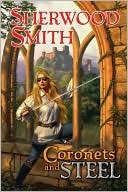
Coronets and Steel by Sherwood Smith. (Fiction; perfectly suitable for teenagers, as well)
Initial impressions: A smart, swash-buckling adventure story, a la Prisoner of Zenda, with just a touch of supernatural thrown in. The protagonist, Kim Murray, goes to Europe to try to trace her family's mysterious history and gets mistaken for someone else. I can't say much beyond that without ruining the story. I'm really enjoying it, and eagerly anticipating where it's going. I think it's the start of a series, 'though I don't know how many books are planned.
(I have to get this off my chest: I DO NOT like this cover. And the sunglasses make it even worse. Except for the Wren books, I don't think the publishers have done a good job with any of her book covers. Okay. There. I feel better.)
On My Nightstand:
 
Here are the books I have lined up to read next. I'm still working on reading the unread books from my own bookshelves. I did just get one hold in from the library which I must read first: Junonia by Kevin Henkes (not pictured.)
Any suggestions as to which ones I should read next?
Igraine, the Brave by Cornelia Funke (Middle Grade)
The Tapestry of Love by Rosy Thornton (Adult Fiction)
Young Joan by Barbara Dana (Middle Grade)
The Marriage Bureau for Rich People by Farahad Zama (Adult Fiction)
The Three Weissmanns of Westport by Cathleen Schine (Adult Fiction)
The Bread Winner by Arvella Whitmore (Middle Grade)
Confessions of a Closet Catholic by Sarah Darer Littman (Middle Grade)
North of Beautiful by Justina Chen Headley (Young Adult)
I'd Tell You I Love You, But Then I'd Have to Kill You by Ally Carter (Young Adult)
Picturebooks On the Kids' Nightstand (from the library):
A Seed is Sleepy by Dianna Hutts Aston; illustrated by Sylvia Long
The Chimpanzee Family Book by Jane Goodall; photographs by Michael Neugebauer
The Scarecrow's Dance by Jane Yolen; illustrated by Bagram Ibatoulline
About Birds: A Guide for Children by Cathryn Sill; illustrated by John Sill
If the Shoe Fits: Voices from Cinderella by Laura Whipple; illustrated by Laura Beingessner
Cloud Tea Monkeys by Mal Peet and Elspeth Graham; illustrated by Juan Wijngaard
Abe Lincoln: The Boy Who Loved Books by Kay Winters; illustrated by Nancy Carpenter
Spectacular Science: A Book of Poems selected by Lee Bennett Hopkins; illustrated by Virginia Halstead

Tuesday, August 16, 2011

Vacation Reads

Is it too late to share what I read in July? I will anyway, 'though it was a pretty light reading month; too many other vacation distractions. But I did manage to read a few good books.

by Joseph D'Agnese

Funky cover, awesome content. This is a series of fascinating journalistic essays on ordinary citizen scientists who are making their own unique contributions in the world. I just like Joseph D'Agnese's approachable style of writing. And he has a knack for making science interesting.


by Meg Cabot

This is a fluffy, fun adult (yes, most definitely adult) romance with a touch of mystery and a whole lot of being chased by bad guys. This is only the second Meg Cabot book, the first being Insatiable a year or so ago. I read She Went All the Way at my sister's house, where, coincidentally, my 15-year-old niece was in the middle of Cabot's famed Princess Diaries series, w
hich she says she's really enjoying. ("And completely different from the movies," she says.)She kept eyeing the book and finally asked if it was by the same author. I said "Yes, but if you touch this book your mother will string me up by my little toes, so hands off, toots."
Oddly enough, I've never read any of Meg Cabot's tween/teen books.


by Maria V. Snyder

Trella is a pipe scrubber, a resident of the Inside: a mysterious, overcrowded world where classes of people (the intellectuals vs. the "workers") are kept separate, and not given much knowledge of each other, or what, exactly is the world they inhabit. When Trella reluctantly goes with her foster brother to meet a prophet claiming the existence of the mysterious Gateway -a portal long talked about, but held by most to be mere myth- she inadvertently starts a growing rebellion against the establishment.
I started reading this dystopian book and didn't want to put it down until I finished. (And for those who care about possible objectionable content: if it were a movie, it would be rated PG for violence, and G -possibly PG- for sexual content, and I don't remember any language.) The sequel is Outside In.