Sunday, May 7, 2017

Book Review: My Name Is Asher Lev by Chaim Potok

What price will you pay to be true to yourself? What price will you pay to let your child be who he/she is? Where should our loyalties lie first? Loyalty to faith vs. loyalty to family vs. loyalty to self. These are all themes explored in Chaim Potok's My Name is Asher Lev. I first read this book almost a year ago. I felt emotionally wrung out by the end of it (in the best way), and didn't have the power to review it. Even now, I know I'm going to struggle to find the right way to talk about it. This post is going to go through many iterations before it finally makes it to print. There's so much I could say, but this is one book I don't want to spoil by saying too much.

I came into this book completely blind: I had no idea what it was about. I wanted to read something by Chaim Potok, and fortunately chose this as my first foray into his books.

My Name is Asher Lev is the coming of age story of a young Ladover Hasiddic Jewish boy, Asher Lev, who is driven by his need to make art. He needs it like he needs air to breathe. He feels about art the way his father feels about his faith. When he is young, this isn't a problem, since the young are allowed to be foolish. But as he grows and the passion grows with him, it becomes a problem with his parents and with his community, who say that a Hassidic Jewish boy should be pouring all his passion into studying Torah. To his father and the Hassidic community, art has no value. At its heart, this is the story of a boy who's passion/vocation for art run counter to his religion's dictums and mores, and the impossibilities of bridging that gap. But it is also the story of a family and the relationship between parental expectation and a child's need to live their own life, on their own terms.

Asher is an art prodigy, and as such is a slave to his art. That's something average Jills like me can't fully understand. But I feel fortunate that I got to live it vicariously through Asher. For a brief while, I got to be inside the mind of a genius. It was exhilarating, and depressing. I love how Potok was able to show the price of genius that those who have it agree to pay, not because they want to, but because they have to; they have no choice, else they die inside. It really captured what I think must be the euphoria and despair that live in symbiosis inside the artist.

Chaim Potok's writing in My Name Is Asher Lev is quietly breathtaking. It's subtle and complex, with a deftness to his turn of phrase that is magical: simple, powerful writing.  I feel like it is his literary masterpiece. I have not read another of his books, so far, that I like nearly as well. (Sadly, even this book's sequel, The Gift of Asher Lev, didn't have the deftness, caliber, or emotional impact of this book. I decided to next tackle The Chosen, because it's probably Potok's most famous, and widely read book, but I was disappointed in it.)

I'm wondering - and this is pure speculation on my part- if Potok felt dissatisfied on some level with his first book, The Chosen, which has very similar themes and situations, and he felt the need to revisit the same themes from Danny's perspective. But since Potok himself was also a painter, and knew the world of art, he decided to make the story about an art prodigy instead of an intellectual prodigy like Danny was.  My Name is Asher Lev was the kind of book I'd hoped The Chosen would be and wasn't. It has a depth of thematic exploration and nuance that never gets fully explored in The Chosen.

(My 13 year old came upon me sobbing -and I am not given to sobbing, as a general rule- during a particular, emotional scene in the middle part of the book, and wondered if she might read it. I am strangely reluctant for her to read it, not because of anything I object to in the book, but because I think this is the kind of book that's "wasted" on the young. She doesn't have enough life experience to grasp the depth of the themes, and I want her to read it for the first time when she's ready for it. But of course, ultimately that is not my decision.)

There are so, so many themes to explore in depth, but I won't, here. Go read the book.


Saturday, May 6, 2017

Getting Rid of Lice The Non-Chemical Way

I know first-hand the shuddering feeling of ickiness when you discover that your child has lice.  
Lice are a pain in the never-mind-where, but there's no need to resort to dangerous chemicals. The method I'm teaching here catches the adults and nymphs and prevents them from laying more eggs. 
So take a deep breath, and know that you've got this. You are going to need:
  • Lice combs with metal teeth are best. Make sure you have the set that contains two sizes, like this one for example.
  • De-tangling spray, Suave or Johnson & Johnson
  • A black garbage bag. Yes, black. You'll see why later.
  • A roll of toilet paper.
  • A comfortable place to sit, but not in your living room, with it's cushioned couches. A stool, a kitchen chair, or an exercise ball is preferable, where you can put the first four things within easy reach.
  • Either a book or electronic device that the child can read/do while this all takes place. It'll take twenty minutes to a half-hour for long hair. Much shorter for short hair.
First things first: Get your de-lousing station set up, with the black garbage bag spread open near right by where your feet will be when you sit down. Don't sit yet. 

Next, you need to douse your child's head under the shower sprayer, or running tub water...whatever will get your child's head thoroughly wet. (Water temporarily immobilizes lice.) While your child's head is hanging dripping over the tub, loosely wrap a towel, turban style, around their head, to keep the water from drenching them when they stand upright.

Next, move to your de-lousing station. Make sure the child is sitting at your feet in a way that allows you complete access to all their hair. Lower the towel to drape around your child's shoulders while you spritz their hair thoroughly with the de-tangling spray. This accomplishes a couple of things: it makes combing through the hair a non-painful event and it keeps the lice wet and immobilized.

When you have thoroughly sprayed with de-tangler, pick up your roll of toilet paper and tear off a long strip and drap it over your non-dominant leg. This is going to be your comb wiping medium. Next, pick up your largest lice comb, and systematically comb through the hair. Every time you make one pass with the comb, firmly sandwich the comb with end squares of toilet paper, and firmly wipe down the tines. You can open your hand and check for lice in the square of TP you just used to wipe. (Don't worry; they're still dazed by the wet. The white of the paper makes it easy to see the adults and nymphs.) Fold over used square of toilet paper in a way that traps the lice, tear it off your long strip and put it in your garbage bag. Comb through another section. Try to think of your child's head as zones, so that you thoroughly comb through each part of their hair, wiping on a new stretch of toilet paper with each pass. Also remember to keep spritzing with the de-tangler to keep the hair wet and the lice immobile. When you get to the end of the length of toilet paper, pause and get yourself a new long length to drape over your leg.

When you have made a thorough pass with the large comb, which combs out any tangles less painfully and also grabs most adult lice that are currently alive, switch to the smaller lice comb and do the exact same thing as before. (The smaller comb catches the nymphs better.) Don't worry about getting the eggs out. It's impossible (despite what you may have heard), since they are glued on the hair. Using this process, you are waiting for the eggs to hatch to nymphs and combing the nymphs out before they can become breeding adults. So basically every time you do a comb-out, you are capturing all the new nymphs that have grown to the size that can be captured by the teeth of the smallest lice comb.

When you have thoroughly combed through your child's hair using both combs, gather and tightly cinch up your garbage bag and take it outside to sit in the sun. The black of the bag gathers the sun's heat and bakes the lice. But leave it outside all day. And then throw it in an outside garbage can.

Next gather your lice combs and put them in a bowl over which you pour boiling water and let them sit for 10 minutes.

Now you must deal with bedding. During all these days of your child's lice-infestation, wash their bedding (all of it) every day. It's not necessary to use the hot water wash, as long as you use the dryer to dry all the bedding. If you have duvets or things that can't be washed, gather them into a black garbage bag and let them sit for 40 days (tightly bagged) in the garage, to be sure that you are killing all the lice over their hatching and life cycle.

Some people say you only need to do the combing once a day. Me, I'm taking no chances. Do it morning and night and you'll be sure to catch those hatching nymphs before they can mature, breed and make more eggs.  

Continue the comb-out and bed linens washing routine until you have gone a few days without seeing any more nymphs during the comb-out, and you don't see anymore eggs. As long as there are eggs, you must keep up the routine.

Any questions?

Wednesday, September 14, 2016

Audiobook Review: Splendors & Glooms by Laura Amy Schlitz, narrated by Davina Porter

My thoughts after listening to this book: Wonderfully written (and very excellently narrated by Davina Porter), but way too long, especially given the nature of the book, and its unrelenting gloom. I have come to the conclusion that this is not a children's book: it is a book about children. The writing is beautiful and descriptive, but it took forever to get to the point (for a children's book.) This book seems to be more of an atmospheric character study, rather than plot-driven, which isn't bad for a book, but doesn't seem like a great idea for it's intended audience, 8-12 year olds. My two older daughters (ages 11 and 13) read it (or tried to, in the case of the 11 year old) before I did and were not impressed with the book.

Don't let my impressions stop you from reading it, or, better yet, listening to it. It may be right up your alley.

On the narrator, Davina Porter: I was so impressed with her narration. She did a superlative job with the characterizations, accents, everything. I will seek out more of her work.

Tuesday, July 5, 2016

Book Review: The Good Lie by Robin Brande

This book challenged me emotionally and intellectually. I'm going to start off by saying I did not like this story, because it made me extremely uncomfortable, which is why I'm going to highly recommend that you read it. Read it now. It is a brilliant, nuanced novel about a religious girl who deals with issues outside of and at odds with her religious experience.  I thought the author did an amazing job of both respecting religion through her main character's eyes while at the same time laying bare it's glaring weaknesses. It's a book that poses more questions than it answers.

A brief synopsis: Lizzie Aimes is living her life as a normal sixteen-year-old Christian teen. She's a good student, she loves her family (especially her little 8 year old brother) and is trying to live her religion despite her sexual desires and a massive crush on a certain boy, who seems set on sleeping his way through the school's female population. Up until the night of her prom, that was her biggest problem. In the weeks and months following, Lizzie life begins unravelling in all the worst ways imaginable, culminating in her need to tell "the good lie."

While it is a novel about a deeply religious girl, this is not a religious book. There are a lot of girls like Lizzie in the world. So many times I wanted to yell at Lizzie for her actions or inactions. But having been a conservative religious teen myself, and remembering certain situations I encountered that were outside my religious training, I can understand the moral quandary and torpor she finds herself in.

As I continue to ponder this book, a week after I read it, the biggest issue that I find myself circling back to again and again, is sexual repression. It is one of the most dangerous by-products of religion, in that it creates an atmosphere ripe for pedophilia to thrive in the religious world, as too many children have found out. It takes away children's voices; since they're never allowed to talk about sex, they don't have the words or knowledge of how to report abuse. One of the major themes of The Good Lie is that dichotomy of sexual repression and the conservatively religious teaching/drilling of sexual abstinence and purity of mind and body when it bumps up against the harsh reality of world scenarios, and how damaging it can be for women and children. 

So, go read this book and be challenged.
 

(Be aware that this book is for mature readers. It contains profanity and frank language regarding sexual functions and situations, and pedophilia. While none of it feels gratuitous, it can be shocking.) 

Sunday, December 27, 2015

A Peek at Life Right Now


  • We recently returned from a family vacation to Disney World and Universal Studios in Orlando. It was the first time at a Disney park for my kids. We went with my sister and her family and my parents. My sister got us a great deal on a condo for the week that was pretty centrally located. Despite uber sore feet each night (on my part), we enjoyed ourselves immensely. We stupidly, amateurishly packed too much into the week, going to a park per day, which ended up being way too much, and left no downtime for relaxing and enjoying each other's company. My poor dad came to Orlando on antibiotics for bacterial pneumonia, so I pushed him around the parks in a wheelchair. My niece also came to Orlando unknowingly with pneumonia, so she ended up on meds in a wheelchair too. We were sad when the week came to an end and we had to say goodbye.
  • We drove to Orlando, leaving our house at 11p.m. on the 10th of December and arriving in Orlando in time to pick up my parents from the Orland International Airport at four something the next afternoon. On the drive to Orlando, when it was my turn at the wheel, I listened to Chime by Franny Billingsley. Susan Duerden narrates fabulously. I've read it before but this is the first time listening to it. My kids and husband couldn't figure out what was going on and quickly went back to listening to their own things on their Kindles or sleeping, in the case of my husband. On the drive back a week later, Todd and I listened to half of Rogue Lawyer by John Grisham. Susanna listened to the first book of The Land of Stories by Chris Colfer at Karina's urging on the drive there, and On My Way and I'm Still Scared by Tomie dePaola (both part of the 26 Fairmount Avenue series) on the way back.  Karina listened to Summerkin by Sarah Prineas on the drive there and What a Year by Tomie dePaola (another 26 Fairmount Avenue book); on the way back. Olivia didn't listen to anything on the drive to Orlando, choosing instead to crochet. On the way back she listened to Tomie dePaola's I'm Still Scared because she couldn't remember it from when we read it aloud. (This series of books has been a favorite with all my girls. They make great read-alouds. The audiobooks make for fun listening too, because Tomie dePaola narrates most of them, and he is wonderful.)
  • I didn't get tons of reading done in Orlando, but I managed to complete one book: Ivory Ghosts by Caitlin  O'Connell. I appreciated the walk down memory lane, having spent four years in southern Africa, but I found the writing awkward and the story not especially compelling, though the subject matter is important. I've read O'Connell's compelling non-fiction books about her elephant research, and love them, but she seems uncomfortable as a fiction writer. That's not to say she can't/won't grow into it.
  • Olivia dropped her camera on the tile floor of the condo we were staying in in Orlando and it broke something inside. She was devastated, since she uses it all the time. When we got home, feeling she had nothing to lose, she opened up the casing to see if she could see where the problem was. She couldn't find anything broken, and on a whim, took a picture with the case open. The picture was normal. So she closed the case back up and the picture was bad again. She started to crack the case back open with the camera on, and as soon as she cracked one side, the picture on the display cleared up again. Long story short, she figured out that there is a wire that was jarred loose by the drop. Somehow she fixed it, and now her camera takes pictures as if never dropped. That's my clever girl.
  • Our dogs survived their week in the boarding kennel. The kids survived the separation too, though that was doubtful when we dropped the dogs off. Many silent tears were shed. Even by people who claimed to be relieved to be getting the break. The day we picked the dogs up, they saw us coming and got super excited. The staff provided us with a Santa picture in the out-processing paperwork when we paid the bill. Those perky heads mean there were treats involved.
    Wishbone is in front; Lego behind. Poor Santa thinking, "What the heck did I get myself into?!"
  • When we got the dogs home, they gamboled around in joy. They have developed colds, and are in turns more clingy and more standoffish than usual. Wishbone, who's quite the mama's boy, alternates leaning into me for extra loves and standing at a room's distance away from me, with his back to me, pretending to ignore me, but really looking at me out of the corner of his eye. He's gonna hate me for putting him back into the kennels in a few days when we go to Nashville. Lego just can't get enough love from everyone.
  • The girls were glad to get home, despite the fun they had in Orlando. The night we got home they disappeared into their rooms to their various activities: Susanna to her imaginary world with her posse of animal friends that she had to leave behind; Karina to clatter away on her typewriter, working on her spy novel; Olivia to crochet.
    Susanna's posse of friends: (L-R) Brisk, Ash, Katie, and Puppy.
    Brisk the stick horse and Ash the dragon are the ones she carries around all the time at home. Other friends join them occasionally.
  • For Todd's birthday, we went to see the long-anticipated Star Wars: The Force Awakens. It was good, but also kinda disappointing. It seemed to have many story elements of the original Star Wars movie, and there was a lot of backstory missing. 
  • Christmas was low-key. Back when we planned and arranged the trip, we told the girls that Orlando was their Christmas, which they were fine with. The girls put up our tree on the 21st, two days after we got home. (They are solely responsible for putting up the tree each year, which they love. Todd and I come to ooh and agh when they're finished.) We did get them three small presents each, 'though we skipped the stockings this year. Karina and Susanna got two small Lego sets and a field sketch watercolor set. Olivia got one small Lego set, the Star Wars crochet kit that she'd been pleading for and the field sketch watercolor set. I loathe wrapping paper both for it's wastefulness and for how time-consuming it is on the wrapping end of the timeline. I opted instead to stack their presents on the sofa in a separate pile for each girl, covering the stack with a colorful tea towel. On Christmas morning, I just had them stand in front of their prospective stacks and counted "one-two-three-GO," upon which they pulled the towel from off their stack. (It is a family tradition that the family goes to the Christmas tree all together on Christmas morning, no early looky-lous, after Mom has first turned on the tree lights and Christmas music.) They declared themselves thrilled with their haul and happily went off to start their various Lego or crochet projects while I made French Toast for breakfast.
The mandatory picture on the stairs before they're allowed to go to the tree.
We actually got decent smiles out of them this year!
  • Here is the Chewbacca figure that Olivia has started from her kit. She still has to complete his arms and other small details. You'll notice the arm in the picture is being held on by pins until she gets a chance to sew it on (hence the trailing brown yarn.) She creates the hairiness by brushing the finished body and arms with a wire slicker brush.

Thursday, October 22, 2015

Exploring Doll Making

By Olivia

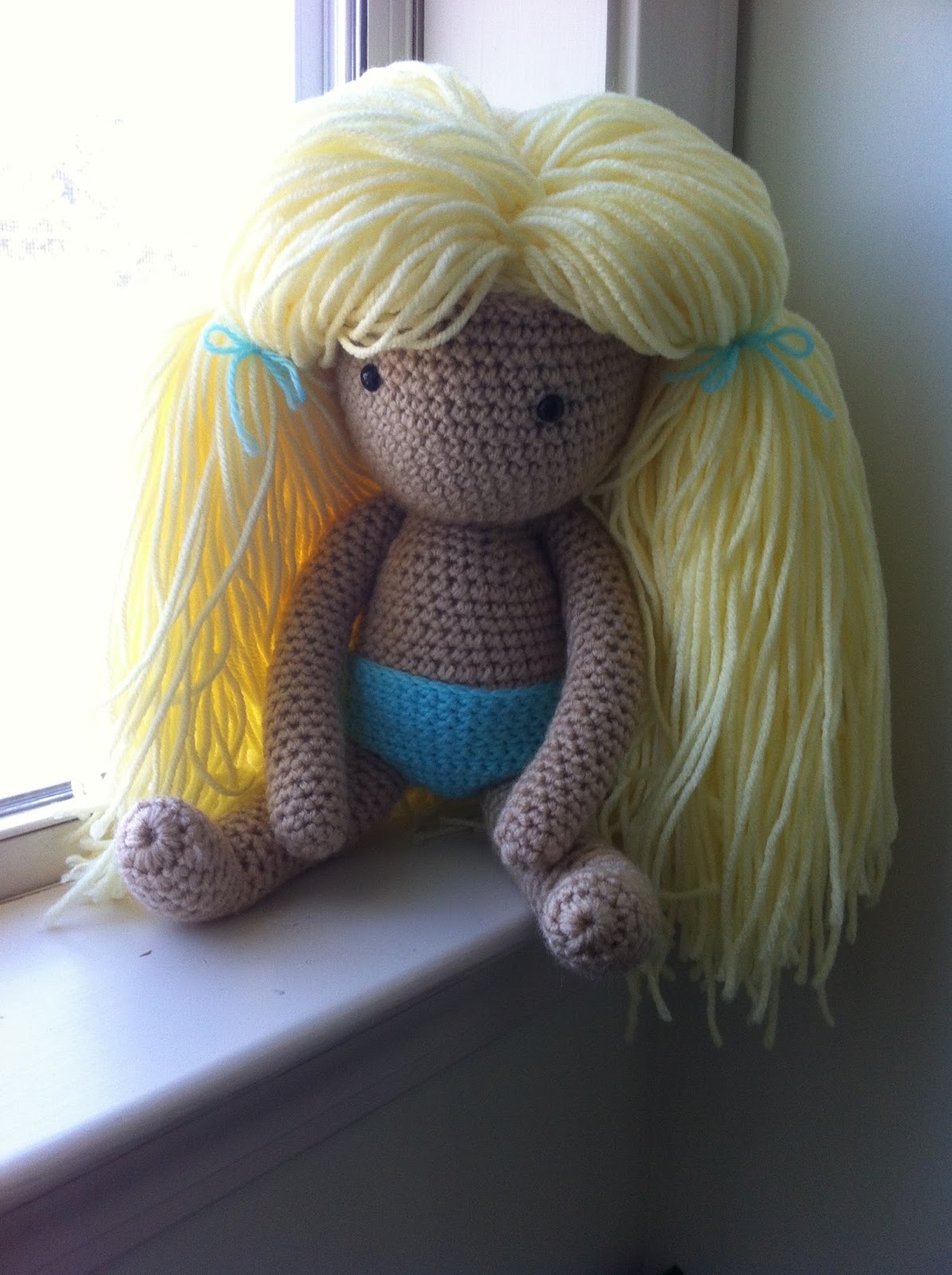
One of my favorite crochet books is My Crochet Doll by Isabelle Kessedjian. I found it while browsing at Barnes and Noble and thought the patterns were super cute. The problem that I had was that this book is written in UK terminology so I had transpose the stitch terminology (for example, double crochet in the UK is single crochet in the US). Using the book I have made three dolls so far. The first one was a present for my younger sister's 8th birthday, along with the Little Red Riding Hood outfit and a little purple fabric quilt and pillow.

The first one took me 3 months because of the hair. I attached the strands one by one so it took forever. I used a G/4.25mm hook with Red Heart Super Saver yarn in Buff for the body color and Caron Simply Soft in Black for the hair.

Then I decided to make a second doll with crochet thread and a 12/1.00mm hook just to see if it was possible to do.  It turned out to be far trickier. It took me 2-3 weeks. The hardest part was sewing the limbs together, especially sewing the scalp to the head. It was so hard I had to use a magnifying lamp. I wish I could accurately portray in words and photos how much time, skill and coordination it took. I mean, you can barely even feel the hook, much less see it. Most of it was done by feeling the hook and stitches. I accidentally dropped a few rounds but it came out better for having done so.

(Just for size comparison, the big doll is 14 inches and the small doll is 4 inches.)

For the third doll I used the same hook and skin color as the first doll but used Red Heart Super Saver in Pale Yellow for the hair (with the same skein as before for the body.) This time I knew what I was doing so it only took me a week. The hair and scalp only took 5 or 6 hours to do instead of taking 3 months because I changed my technique. (The book gives no instruction on how to actually do the hair.) This time instead of attaching the hair strands one by one with a needle, I wound the yarn around a piece of cardboard and attached the hair strands 2 or 3 at a time with a smaller crochet hook.


Tuesday, April 14, 2015

Book Review: The War That Saved My Life by Kimberly Brubaker Bradley


Review by ten-year-old Karina:


It's about a ten year old girl named Ada, a London evacuee during World War Two. Her mom keeps her locked up all the time because she has a crippled foot and her mom is embarrassed about it. She is physically abused by her mom: locked in the cupboard when she does something bad, and hit a lot. She wasn't supposed to leave London, but she sneaks out with her little brother when he goes to the school on evacuation day. When they get off the train in the country, Ada and her brother, Jamie are sent to live with a woman named Susan Smith. At first Susan Smith doesn't like the kids, because she didn't even want evacuees to stay with her, and they didn't trust her, but eventually they learn to like and trust each other. Under Susan's care, Ada's world expands a lot.  She gets regular baths. She gets crutches to help her walk. She learns to ride a pony, and then helps care for them. She's given the freedom that other kids enjoy. Susan never hits her, but at first Ada is fearful of her, because she's learned to dodge her mother's fists. It takes Ada a little while to learn that Susan isn't trying to hit her, she is trying to help her when she reaches out to her. I won't tell you the rest of the story so you can have the fun of reading it yourself.

I don't normally read historical fiction, but when I read the description and saw it was about a ten-year-old girl (like me) I decided to give it a try. Plus the description of the story sounded like it might be interesting, so I decided to give it a try. My mom says I have to give a book a chance for at least 50 pages, but I was hooked before 50 pages. Even though I don't really like historical fiction, it was interesting to read about something that happened to a girl that was my age, during World War Two. It was an eye-opener for me, and I learned a lot from the book: I kind of knew that women helped out in the war, but I didn't realize the big role they played; I didn't know that superstitious teachers tied kids left hands to their chair if they were left-handed. The book made me feel sad and happy at the same time. Now it's on my list of all-time favorite books. I would definitely recommend this book. I bet if you read it, it would be one of your favorites, too.

Wednesday, February 11, 2015

Book Log - January 2015

Megan:
  • Beyond the Sunrise, by Mary Balogh (adult fiction)
  • The God Delusion, by Richard Dawkins (audiobook, narrated by Richard Dawkins and Lalla Ward; non-fiction)
  • How Jesus Became God: the Exaltation of a Jewish Preacher from Galilee (audiobook, narrated by Walter Dixon; non-fiction)
  • Misquoting Jesus: the Story Behind Who Changed the Bible and Why, by Bart D. Ehrman (audiobook, narrated by Richard M. Davidson; non-fiction)
  • Stranger at the Wedding, by Barbara Hambly (audiobook, narrated by Anne Flosnik; adult fiction)
  • Under the Banner of Heaven, by Jon Krakauer (audiobook, narrated by Scott Brick; non-fiction)
  • The Masqueraders, by Georgette Heyer (audiobook, narrated by Ruth Sillers; adult fiction)
  • Neverhome, by Laird Hunt (adult fiction)
  • The Great Greene Heist, by Varian Johnson (middle-grade fiction; DNF)
  • The Serpent's Shadow, by Mercedes Lackey (audiobook, narrated by Michelle Ford; adult fiction)
  • Danse de la Folie, by Sherwood Smith (audiobook, narrated by Heather Wilds; adult fiction)
  • Crown Duel, by Sherwood Smith (audiobook, narrated by Emma Galvin; young adult fiction)
  • Code Name Verity, by Elizabeth Wein (audiobook, narrated by Morven Christie and Lucy Gaskill; young adult fiction)
Olivia:
  • Cesar's Way, by Cesar Millan (non-fiction)
  • Cesar's Rules, by Cesar Millan (non-fiction)
  • K.I.S.S. Guide to Raising a Puppy, by Liz Palika (non-fiction)
  • Training Your Superpuppy , by Gwen Bailey (non-fiction)
  • 15 Minutes to Great Puppy, by Kevin Michalowski (non-fiction)
  • Unlock Your Dog's Potential, by Sarah Fisher (non-fiction)
  • and many more dog books
  • Son, by Lois Lowry (audiobook narrated by Bernadette Dunne; young adult fiction)
  • All the audiobooks of the Hurculeah Jones series by Betsy Byars (middle-grade fiction)
Karina:
  • All the audiobooks from the series A Series of Unfortunate Events by Lemony Snicket (children's fiction)
  • All the audiobooks of the Herculeah Jones series by Betsy Byars (middle-grade fiction)
  • How To Train Your Dragon, by Cressida Cowell (audiobook, narrated by David Tennant; children's fiction)
  • Meet the Austins, by Madeleine L'Engle (audiobook, narrated by Maggi-Meg Reed; middle-grade fiction)
  • Where There Is No Doctor, by David Wermer with Carol Thuman and Jane Maxwell (non-fiction)
  • Weirdos From Another Planet: A Calvin and Hobbes Collection, by Bill Watterson (graphic novel; fiction)
Susanna:
  • Babymouse: Queen of the World, by Jennifer L. Holm and Matthew Holm (graphic novel; children's fiction)
  • Babymouse: Our Hero, by Jennifer L. Holm and Matthew Holm (graphic novel; children's fiction)
  • Babymouse: Beach Babe, by Jennifer L. Holm and Matthew Holm (graphic novel; children's fiction)
  • Babymouse: Puppy Love, by Jennifer L. Holm and Matthew Holm (graphic novel; children's fiction)
  • Babymouse: Mad Scientist, by Jennifer L. Holm and Matthew Holm (graphic novel; children's fiction)
  • Happy Birthday, Babymouse!, by Jennifer L. Holm and Matthew Holm (graphic novel; children's fiction)
  • Something Under the Bed Is Drooling: A Calvin and Hobbes Collection, by Bill Waterson (graphic novel; fiction)
  • The Indispensable Calvin and Hobbes, by Bill Watterson (graphic novel; fiction)

Sometimes the Movie Is Better Than the Book

We book lovers can be very vocal in our defense of beloved books and downright scornful of any attempt at reinterpreting an author's work. In this post I won't go into the irritated befuddlement I feel over a really bad interpretation, in which they (meaning Hollywood) ruin a delightful story (Ella Enchanted - 2004) or change the story so much that the book seems to have been used only for its title and a few very basic story elements (Cheaper By the Dozen - 2003, Mr. Popper's Penguin's - 2011.)
It doesn't happen often, but sometimes the movie maestros make a movie that is as good as the book, even when they change a few elements of the original story. (I'm thinking of Lord of the Rings and the BBC's Wives and Daughters.)
On a rare occasion, the movie is better than the book, although admittedly this might not be the same for everyone. Here are a few movies that in my subjective opinion surpassed the books on which they were based:

BBC's North and South1. BBC's North and South (2004) - based on Elizabeth Gaskell's novel of the same title.

While I like the book, the TV serial is so much better, and the characters much more realistic, less wooden, and it gives the main characters a worthy, swoon-inducing reconciliation, while the novel's scene of reconciliation is incredibly anti-climactical and boring.

The Magic of Ordinary Days2. The Magic of Ordinary Days - based on Ann Howard Creel's novel of the same title.

I just couldn't like this book. I wanted to and fully expected to because I loved the Hallmark Hall of Fame movie. It just didn't happen. The main character was annoying, snobby, whiny, selfish, uncompassionate and she didn't improve. And the man she marries has the personality of a wet dishrag. I think the book suffers from want of some serious editing, and too often the author goes into annoying, long history lessons. The movie, on the other hand, has a marvelous screenplay, having removed the junk from the book and cut it down to the basic story: a pregnant, cultured, smart, standoffish young woman makes a marriage of convenience with a Colorado farmer during World War II. His simple ways and quiet devotion to their marriage and the coming baby (which is not his) teach her some much-needed lessons in compassion and unconditional love.

The Princess Bride3. The Princess Bride - based on William Goldman's novel of the same title.

The movie is much more charming, swashbuckling, adventurous, interesting, and humorous than the book, and it gave us fabulous quotes to spout: "When I was your age, television was called books." "Inconceivable!" "You keep using that word. I do not think it means what you think it means." "Life is pain, Highness. Anyone who says differently is selling something." "They're kissing again. Do we have to read the kissing parts?" "My way's not very sportsman-like." I didn't dislike the book, I just felt that the movie made the story better; it cut out all the superfluous.

The Last of the Mohicans (1992)4. The Last of the Mohicans - the 1992 film based on James Fennimore Cooper's book.

This lush production is very different -more intense, exciting, romantic - than the 1826 novel, thank goodness. I've tried to read this book for years and each time I give up out of intense boredom. I'm content with just enjoying this movie version.


What movies are on your better-than-the-book list?

Book Review: Shadows by Robin McKinley


Synopsis from the publisher: Maggie knows something’s off about Val, her mom’s new husband. Val is from Oldworld, where they still use magic, and he won’t have any tech in his office-shed behind the house. But—more importantly—what are the huge, horrible, jagged, jumpy shadows following him around? Magic is illegal in Newworld, which is all about science. The magic-carrying gene was disabled two generations ago, back when Maggie’s great-grandmother was a notable magician. But that was a long time ago.
Then Maggie meets Casimir, the most beautiful boy she has ever seen. He’s from Oldworld too—and he’s heard of Maggie’s stepfather, and has a guess about Val’s shadows. Maggie doesn’t want to know . . . until earth-shattering events force her to depend on Val and his shadows. And perhaps on her own heritage.
In this dangerously unstable world, neither science nor magic has the necessary answers, but a truce between them is impossible. And although the two are supposed to be incompatible, Maggie’s discovering the world will need both to survive.

Some authors' books are automatic buys for me. Robin McKinley is one such author.
The story is set in a contemporary-ish, maybe future-ish alternate earth- a world that in many ways is familiar to the modern reader, but contains plenty of the unfamiliar. I was confused for awhile about the workings of the world of Shadows. McKinley uses unfamiliar words for things that aren't well-described at first. Only bit by bit does the reader glean the inner workings of the world in which Maggie, the main character, lives. I still don't feel like I have a complete handle on it.
McKinley writes people well. None of her characters succumbed to archetypical portrayals. They were all authentic, real, relatable people. I liked the slightly scattered but grounded voice of Maggie, the main character, who is trying to find her place in the world and in her family, now that her mom has married a man Maggie completely distrusts. She doesn't, strangely, seem to be thinking about the future. (I say "strangely" because she is in her last year of high school.) All her concerns are with the present, maybe because her stepfather and his shadows are seriously creeping her out and messing with her worldview. The stream-of-conscious narration was a little confusing at times, and I had to keep going back to reread passages because I felt like I had missed or misunderstood something. But as irritating as it could be, it also loaned authenticity to Maggie's teenage self.
I also like how she tied up the story, but left plenty of room for imagining what would come next for these people.


*This post originally published on October 2, 2013

A Dictionary For Book-Loving Kids (and Adults)

Image
Book lovers tend to love dictionaries and also tend to have a few different copies lying around the house. (Our current number is five. I know. It might be a sickness.)  But a dictionary that contains a plethora of quotes from children's literature to help define the words? Guaranteed to become an instant favorite. Merriam-Webster's Elementary Dictionary (for kids aged 8 through 12 years) was an instant hit with my girls when they saw that quotes from books they've read and loved are used to help provide context for the definitions. This book never stays shelved. I find it lying all over the house. As a book-loving, book-pushing mom, this makes me so happy.


*This post originally published on August 17, 2013

Book Review: Evolution, Me & Other Freaks of Nature by Robin Brande

For those who haven’t read the book, here’s a very brief synopsis: Mena, an Evangelical Christian on the outs with her own Church, for reasons not made clear at first, starts high school as a social outcast, but getting assigned to Ms. Shepard’s biology class starts to change her world.
The book deals with themes of evolution vs. creationism, bullying, and prejudice. I was fascinated with Mena’s character growth in this very readable book. Sadly, I can foresee some Creationist-minded Christians trying to get this book banned from school libraries, which would be a shame, because Brande created characters who are ethical, caring, interesting and realistically normal at the same time. Some other reviewers on GoodReads have complained about the one dimensional characters of the religious kids, when the reality is that the attitudes and behavior displayed by the religious kids makes them seem pretty one dimensional, just as it does in real life when people behave similarly. Having witnessed first hand the mass ignorance and bad behavior displayed by so-called "intelligent" design (aka Creationism) fans toward those who disagree with them, I found the book very realistic in its portrayal of the characters and situation. (And yes, I'm aware that the situation could be reversed as well, but that has not been my experience.)
The part I thought wasn’t fleshed out well was Mena’s relationship with her parents.  She obviously loves them, but never seems to question why they wouldn’t support her or show more empathy toward her. Surrounded as she was by hate and vitriol on all sides, I’m surprised she seemed so calm (relatively speaking) and accepting.


*This post was originally published June 23, 2013

Book Review: Tales From the Brothers Grimm and the Sisters Weird by Vivian Vande Velde

My nine year old daughter found this in the Junior Fiction section of the library. She tossed it disgustedly on the return pile a few days later, saying, "This book is dumb. I don't like the way the author redid the fairy tales." Since she's not a big fan of fairy tales anyway, I decided to read it to see if she was right, or if she just didn't appreciate it because of the genre.
The answer, I found, is a little of both. After reading this compilation of "twisted" fairy tales (and it's a quick read) it's clear to me that the book has been wrongly placed in the library: it isn't a book for the 8-12 age range, unless you've got a kid who's ahead of his/her years, irony-wise. The cultural references, dark humor, and general irreverence are more suited for teens and adults. The stories themselves are well-written, and amusing in places, (and secretly echo some adults' feelings about certain iconic fairy tales) but for the most part, I myself couldn't work up much enthusiasm over them. But I can definitely see a more appreciative audience out there for it.

*Originally published on June 14, 2013

Sunday, January 13, 2013

Reading by Candlelight at 4:30 in the Morning


A severe thunderstorm knocked out our electricity around four this morning, and sent my girls scurrying to our room in fright. Todd stayed fast asleep, but since there's not room in our bed for all five of us anymore, and they weren't going back to bed with the terrible rumble going on, we four girls headed into the living room, lit some candles and sat reading or coloring. I happily re-entered Elizabeth Gaskell's North and South to read more of John Thornton and Margaret Hale's Milton world. Olivia was reading Roald Dahl's Matilda (which she's really enjoying and feels compelled to read me the funny bits) and Karina started out with a Nancy Drew book, but soon joined Susanna on the floor for some coloring. Thankfully it was not a cold morning. The power stayed out until 7:30 a.m. but we didn't hear it come on, because by that time we were all napping. (Todd apparently woke up when it came on.)

I'm loving North and South, but I'm not happy with the version I'm reading. It's published by Norilana Books (the cover pictured), but it reads like an unfinished editing job. Quotation marks are missing. Paragraphs aren't broken up properly, which ruins the flow of the story. It makes things slightly confusing until I mentally readjust the paragraph break. I really want to reread it in a better format. Any suggestions as to good versions?

Saturday, December 29, 2012

Book Review: Tiger Lily by Jodi Lynn Anderson


I should start this review with two confessions:

  • I never read the original Peter Pan by J.M Barrie. But I have seen the stage play and of course I've seen Disney's version.
  • I have an aversion to spin-off books/fan fiction.
You probably know where this is going. 
I think fan fiction authors tread dangerous waters when they twist another author's story and characters to their own devices, especially such an iconic story as Peter Pan. They open themselves up to much more criticism than normal. But they've walked the gangplank, so to speak, and thus have to swim with the crocodiles.

Let's take a look at some of the basics of Tiger Lily
  • Neverland, in this incarnation, is an island that is magically hidden, and only a few find their way there over the ocean. But that seems to be the only magical thing about it. Everything about it, including the fairies, are discussed in Darwinian terms: the island and its inhabitants just evolved to be the way they are. That not bad, just a complete departure from the original story. (There's no flying to Neverland in this book.) 
  • Tinkerbell plays the mute, bug-eating, Tiger-Lily-fan-girl, non fairy-dust-toting narrator. She spends most of her time in Tiger Lily's village and has watched Tiger Lily grow up. Peter only meets her when he meets Tiger Lily, whom he's apparently meeting for the first time as a teenager. But despite Tinkerbell's muteness, she can apparently see into other people's minds.
  • Tinkerbell talks about the random cessation of growth associated with Neverland. For some reason the pirates are aging, maybe because they sailed there from England as adults? But the natives on the island stop aging at some random point in time. It doesn't appear to be consistent, and the idea is left hanging as an inexplicable element of the island.
  • The main characters, Peter and Tiger Lily are much older than the original, being about 15 or 16 years old, with all the sexual tension that entails. Which feels weird to read, when some of the same things are happening to them as happened in the original story. Peter comes across as  angst-ridden, emotional yo-yo: an innocent bad boy, which sometimes doesn't come across well, given his age in this story. Tiger Lily is the adopted daughter of the trans-gendered shaman of the tribe, taciturn, serious, doesn't show her feelings, and finds it hard to empathize with people, yet truly loves her adopted father. We never really learn what makes her tick. She remains somewhat a mystery throughout the book. Wendy is portrayed as the vapid, boyfriend-stealing wench. Smee is a sociopathic killer, obsessed with Tiger Lily. The whole tone of the book is darker, and the characters are flawed and mostly compelling, which I don't see as a problem, per say, but they just don't reconcile with the original characters. 
  • There is an additional element of magic that is never explained in the book, that exacts revenge on Tiger Lily's enemies. We never learn if it is Tiger Lily herself that causes their destruction, or someone else, or some island magic at work.
  • I would actually have really liked how Tiger Lily's story ended (it makes sense to me, as a married, middle-aged woman with reality, and real love, firmly under my belt) if it weren't for the fact that Pine Sap, the man she marries, her childhood best friend, is deserving of a woman who is emotionally present for him, especially after his abusive childhood. It seems sad to me that in marrying Tiger Lily, he marries a woman as equally emotionally distant as his own mother, although less abusive. It still smacks a little too much of an abuse cycle, although the author keeps insisting that he is very emotionally healthy. If Tiger Lily had shown signs of being different for her experiences, I'd feel better, but as far as the reader can make out, she's still the same old emotionally distant Tiger Lily, pining for Peter Pan.  I don't like Peter's ending.

On the positive side, Jodi Lynn Anderson is a good word weaver, if only the words weren't about iconic characters from an iconic story, most of whom have already been fully formed in peoples minds. If you haven't read Barrie's original, or seen the play, nor feel any loyalty to the original, you will probably like the book. My issues with the book stem entirely from the fact that it's fan fiction. My feeling is, don't mess with a classic. It's not yours to mess with. But I may be in the minority on that issue.


Published in 2012 by HarperCollins Children's Books
Review copy borrowed from the library.

What say you? Are you a fan of fan fiction or do you not want your classics messed with?

Tuesday, December 25, 2012

Christmas Favorites: A New Coat For Anna


A New Coat For Anna
Written by Harriet Ziefert
Illustrated by Anita Lobel

Based on a true story that takes place just after World War II, in an unnamed European town, A New Coat For Anna is the story of how young Anna's determined, enterprising mother, who doesn't have the money to buy Anna the coat she needs, uses the few fine posessions she has left to barter for the goods and services she needs to make Anna's new coat. She trades with the farmer for his sheeps' wool; she trades with the spinner to spin it to yarn; she trades with the weaver to weave the cloth; she trades with the tailor to sew the coat. The whole process takes a year, and Anna and her mother have to participate in the coat's creation too (carding the wool and dying the yarn using lingonberries.) After the coat is finished, just in time for Christmas of the next year, Anna and her mother invite all the people who helped make Anna's new coat possible to a Christmas celebration.

The wonderful, plentiful illustrations by Anita Lobel are perfect for the story, providing enough detail of each stage of the coat's genesis for modern children to understand and feel the work that went into it.

I deeply appreciate that this book gives children an insight into true hardship and inventiveness under trying conditions, without resorting to preachiness. My daughters and I love this story. It's a favorite reread at any time of the year, but especially at Christmas.


Published in 1986 by Random House Children's Books

Sunday, December 23, 2012

Christmas Favorites: The Story of Holly & Ivy

The Story of Holly & Ivy
Written by Rumer Godden
Illustrated by Barbara Cooney

Loneliness and wishing are the themes of this magical classic Christmas story, first published in 1957. Ivy is a lonely orphan wishing for a place to belong. Holly is a doll in Mr. Blossom's toy shop, dressed in Christmas red and green, wishing to find her little girl, fearful of being put into storage with the mean owl Abracadabra because she hasn't been sold this Christmas. Childless Mrs. Jones aches for something she almost doesn't allow herself to wish for. How these three wishes converge and are fulfilled during this wishing time of year make for a riveting story that never feels dated because it touches on themes that are universal to the human condition. This touching story is made more poignant by Barbara Cooney's dreamy, luminous illustrations, of which there are not enough, in my opinion.

I loved this story when I was a girl, and I'm so pleased my girls love it too. This is the first year Susanna sat through the whole reading of this long picture book.


Monday, November 12, 2012

Book Review: Sadako and the Thousand Paper Cranes by Eleanor Coerr; illustrated by Ronald Himler

Sadako and the Thousand Paper Cranes is a short book that packs an emotional wallop through it's simple narrative. It is the true story of Sadako Sasaki, who was only two years old when the atom bomb fell on her city of Hiroshima, Japan. Now it is nine years later, and she discovers that she has the "atom bomb disease" (leukemia).

The book doesn't focus on any political message, nor does it focus on the war. It is simply the story of a young girl dealing with her own sickness and death, as a result of an event she herself doesn't remember. Nevertheless, this is a tough book for kids and one that sparks discussions about a myriad of topics: war, war on civilians, atomic bombs, cancer, family support during sickness, whether children are trusted with information about their own illness, hope or lack of hope, myths and legends on which people pin their hopes, death, fear of death. And yes, one comes away with a very anti-war feeling of one's own.

I borrowed Sadako and the Thousand Paper Cranes from the library to read aloud as part of our world history study. Olivia took it off the stack and read it herself before I had the chance to read it aloud. She soon came back with lots of questions. That sparked Karina's curiosity in the book, so she took it off to read. Much, much discussion ensued on all the topics mentioned previously. (Our copy was the original hardcover, pictured to the right, which contains a brief prologue and epilogue. I understand that later versions also contain discussion points. I wish we'd had that version, but we sure managed tons of discussion that sprang naturally from reading the story, even without a guide.)

I suspect this is a story my girls will forever remember.

Karina's response to my query about her reaction to the book was simple, but she takes longer to process thoughts than Olivia. She said: I thought it was really sad, but really good.

Olivia said:
This is a really sad book, but really worth reading. Until I read Sadako and the Thousand Paper Cranes, I didn't even know America had dropped bombs on Japan during World War Two. It made me sad to think of so many people being killed or infected because of it. The story is good. I loved it. I loved that it was about a real girl. And the pictures helped me to understand some things about the story. I liked the legend of the thousand paper cranes, even though they didn't help Sadako. In the end they did help her since the sight of them moving gently on the breeze gave her comfort as she died. I kept hoping she'd get better, but I realized pretty soon that she just wasn't. I'd definitely recommend it. It's one I'd read again. I think this is a book teachers should read to their students. Warning: reading this book will make you cry, especially the end, so read it with a tissue handy. Don't be afraid of crying; you won't regret reading Sadako and the Thousand Paper Cranes.


Published in 1977 by G.P. Putnam's Sons
Review copy borrowed from the library.

Friday, November 9, 2012

Book Review: Dangerously Ever After by Daska Slater; illustrated by Valeria Docampo

If you're the mother of little girls, you're probably going to encounter princesses at some point in your reading repertoire. This can be delightful or painful, depending on how the author chooses to portray said princesses. The delightful ones get reread with enthusiasm, and the painful, simpering, irritating ones get quietly "lost" in whatever manner deemed necessary.
Never fear, Dangerously Ever After by Dashka Slater and Valeria Docampo will be in the enthusiastically reread category, with no pain involved.

Princess Amanita is not your average princess. She loves all things dangerous, and her garden would make Morticia Addams proud. And then...
"One day, as the princess was watering a patch of itching thistles, a prince from a neighboring kingdom rode up. His name was Florian and he was out looking for for a dragon to slay, or a knight to challenge--or at least someone his own age to talk to."
The prince's arrival sets off a chain of funny events that culminate in the character growth of the princess (and undoubtedly of the young prince, too.)

My girls and I chuckled our way through the appealing absurdity of this refreshingly non-girly princess story. It appealed to my younger princess-loving daughters, and even my older princess-loathing daughter. I can see this being a hit with boys, too, because the traditional princess aspect isn't present. (It will help that the word doesn't feature in the title, but the word "danger" does.) All kids can identify with danger-loving Princess Amanita in some aspect, because at its heart, Dangerously Ever After is the story of a little girl whose way of identifying herself is called into question when she encounters events outside her comfort zone and control, which leads to growth and balance. That sounds heavy, doesn't it? But really that "lesson" is just naturally absorbed into the story.

This is the first book I've read by Dashka Slater, and I'm delighted with the introduction. The story's pacing, language, and length work beautifully as a read-aloud, perfect for ages 4/5 and up. It's one of the few picture books we've read that appeals to all my girls with equal enthusiasm. The illustrations by Valeria Docampo are a delight. Beautiful, vibrant, and fun, they perfectly highlight and compliment the text. The artist's heavy use of blue keeps the fierceness of Amanita's world in check. My girls loved the scorpion tail inspired hair-do, the suit-of-armour dresses, the prince's steed (a bicycle), and the strangely appealing garden.

For what it's worth, my girls and I are giving Dangerously Ever After a hearty thumbs up.


Published in Semptember 2012 by Dial Books For Young Readers
Review copy generously supplied by publisher.

Nominated for the CYBILS 2012 by Charlotte of Charlotte's Library.

Monday, October 29, 2012

Book Review: The Eyes of the Amaryllis by Natalie Babbitt

I beg your indulgence as I set up this review a little, so you can understand the frame of mind I came to The Eyes of the Amaryllis with. My family moved to The Gambia the summer after I turned nine, and there for the first time I met the mystery and power of the sea. It was such a new experience that we glutted ourselves with beach-going several times a week. When my parents wouldn't take us, my older brother and I would cycle to the beach off of the Sunwing Hotel to hunt in tide pools and estuaries at low tide. I loved the ocean - the moods, the sounds, the smells; but I learned to fear it too.  A few months after we moved to The Gambia, our next door neighbor's son, a big, strapping, friendly lad of fourteen, drowned in the ocean. It was shocking and horrifying, the suddenness and manner of his death.

In July after I turned eleven I had my own near-drowning experience. I went swimming off the beach at the American Ambassador's residence during a Fourth of July community picnic, and got caught in the undertow. I got carried a long way out, and couldn't get back in because of the force of the undertow. There were some young Peace Corps Volunteers swimming nearby, but I didn't even have the energy to call to them for help. I faced the terrifying reality that I was probably going to die because there was no way I could muster the energy to try swimming again. I alternated treading water and floating on my back, contemplating death and thinking that I didn't want to die like my poor neighbor friend. I hated the thought of what it would do to my family. Fortunately for me, one of those Peace Corps volunteers could apparently tell I was in trouble, even though I hadn't spoken. "Getting tired?" he asked quietly as he swam up to me. I nodded my head and he put his hand under my armpit. "The undertow's bad today. I'm going to show you how to beat it. Let's swim this way." Swimming by my side, we swam parallel with the beach for a little way, and then he lead us in at an angle. That man saved my life. I was too tired to do more than whisper a thank you when we made the beach. He went off with a little wave and a "You'll be alright now", as I lay heaving on the sand, and I didn't see him again that day, even though I looked for him. I never even learned his name, but I'm alive today because he came along. (I didn't tell my parents of my near-death for years, out of fear that they'd ban me from ocean-swimming. In college I became a lifeguard, and then a life guard instructor and first aid and CPR instructor in an attempt to "pass it on.")

It was a year or so later, when I was twelve I think, that I first encountered The Eyes of the Amaryllis by Natalie Babbitt in the Banjul American Embassy School's library. Written in 1977, it was the first book I read by Natalie Babbitt. There were a couple of her other books on the shelf, but this one sounded the most intriguing, so I read it first. I was instantly captivated by the atmospheric, mysterious story that seemed to capture the hypnotic pull of the sea. It struck me powerfully at the time, I think because of my cumulative experiences with the ocean, and because I, like Jenny in the story, had grandmothers I didn't know very well.

The story takes place in 1880, when eleven year old Jenny (whose real name is Geneva) is being taken to stay with her paternal grandmother, the first Geneva, who has broken her foot and needs help until it mends. Jenny's Gran lives on a bluff in a bay on the Atlantic coast, in the same house she came to fifty years before as a bride.
"To be away from home--to stay with Gran and help her while her ankle mended--this seemed a very grownup thing to do, and Jenny had boasted about it to her friends. But in truth she was a little alarmed about that part, though her grandmother, whom she had seen before only for two weeks of the yearly Christmas season, had long been a figure of romance to her. Gran was not like other grandmothers, smelling of starch or mothballs, depending on the time of the year, and spending their time watering their plants. Gran stood straight and proud. Her face and arms were sunburned. And though she talked and listened, there always seemed to be something else on her mind, something far more absorbing than Christmas conversation.
But Jenny did not care for household chores, and was not at all sure that somewhere in her lay hidden the makings of a bedside nurse. So it wasn't that part of her adventure that excited her. No, the real enticement was the ocean. But this she could not admit. She was the only one of her friends who had never been to the shore. Preposterous, when it was only thirty miles from Springfield! But her father had never let her come, had always refused to discuss it."
Jenny quickly bonds with her unusual Gran, and learns that Gran has been waiting for years for a gift from the sea, a gift from her dead husband. (Thirty years before, Gran's sea captain husband drowned when his ship, the Amaryllis, sank just off the coast of home in a storm, as his wife and child watched from the bluff in helpless horror.) Ever since, Gran has searched the beaches every day at high tide, no matter the time or weather for some memento. (That is, in fact, how she broke her foot.) Now Gran needs Jenny to be her eyes and legs on the beach, and continue the search. But there is another searcher, a mysterious man named Seward, who could not let such a gift be taken from the sea.

I won't tell you anymore. It's the perfect book to read this time of year, if you want a little spookiness.

Twelve year old me loved this book, and because I loved it, I went on to read Tuck Everlasting, which I also loved. I was loath to re-read it as an adult, lest it lose the magic. I'm happy to report, however, that it holds up to adult reading very well, and I caught nuances of the relationship between Gran and her son (Jenny's father) that I didn't fully understand at the time of my first reading, and understand Gran's obsession a little better now, too.


Published in 1977 by Farrar, Straus and Girouux.